Production Description
Excellent Lubricity & Softening Performance: With good oiliness and lubricating effect, it can soften fiber, rubber and plastic surfaces, reduce friction and wear, widely used as lubricant and softener in multiple processing industries.
Reactive Double Bond Structure: Contains a cis carbon-carbon double bond in the molecule, capable of hydrogenation, epoxidation, oxidation and saponification reactions, serving as a key intermediate for synthesizing oleate, azelaic acid and plasticizers.
Skin-Friendly Emollient Property: It is easily compatible with skin lipids, delivering moisturizing and nourishing effects, widely adopted in cosmetics, personal care products and topical pharmaceutical formulations as an emollient and penetration enhancer.
Controllable Oxidation Stability: With proper antioxidant addition and sealed storage, it effectively slows down rancidity and discoloration caused by air oxidation, maintaining stable quality for long-term production and formulation.
Good Surfactant Precursor: It can react with alkalis to produce oleate soaps, which possess outstanding dispersion, wetting and cleaning properties, ideal for making detergents, flotation agents and agrochemical adjuvants.
Multiple Industrial Grade Options: Supplied in industrial grade, cosmetic grade and food grade with strict impurity control, matching different requirements from polymer processing to cosmetic and food additive production.
Parameters
| Melting point | 13-14 °C(lit.) |
| Boiling point | 360 °C |
| density | 0.89 g/mL at 25 °C(lit.) |
| vapor density | 1.03 (vs air) |
| vapor pressure | 52 mm Hg ( 37 °C) |
| refractive index | n20/D1.377 |
| FEMA | 2815 | OLEIC ACID |
| Fp | 133 °F |
| storage temp. | -20°C |
| solubility | Miscible with ethanol, ether, acetone, chloroform, dimethyl formamide and dimethyl sulfoxide. |
| form | Liquid |
| pka | pKa 5.35(H2O,t =25) (Uncertain) |
| Specific Gravity | 0.892 (20/4℃) |
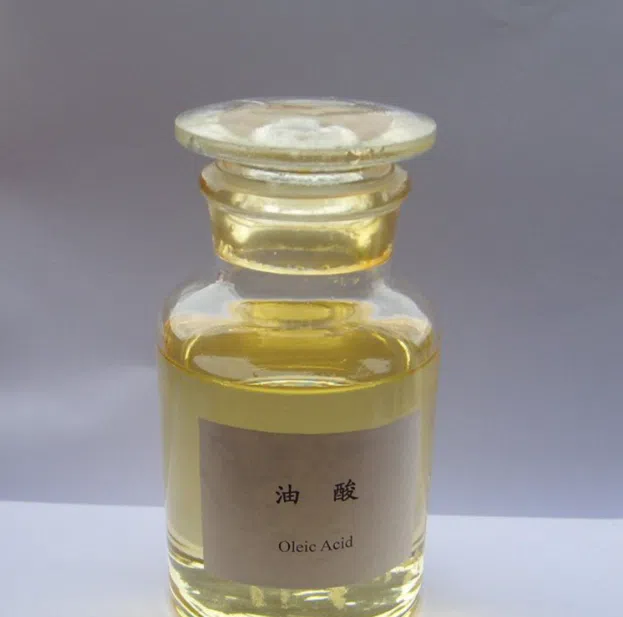
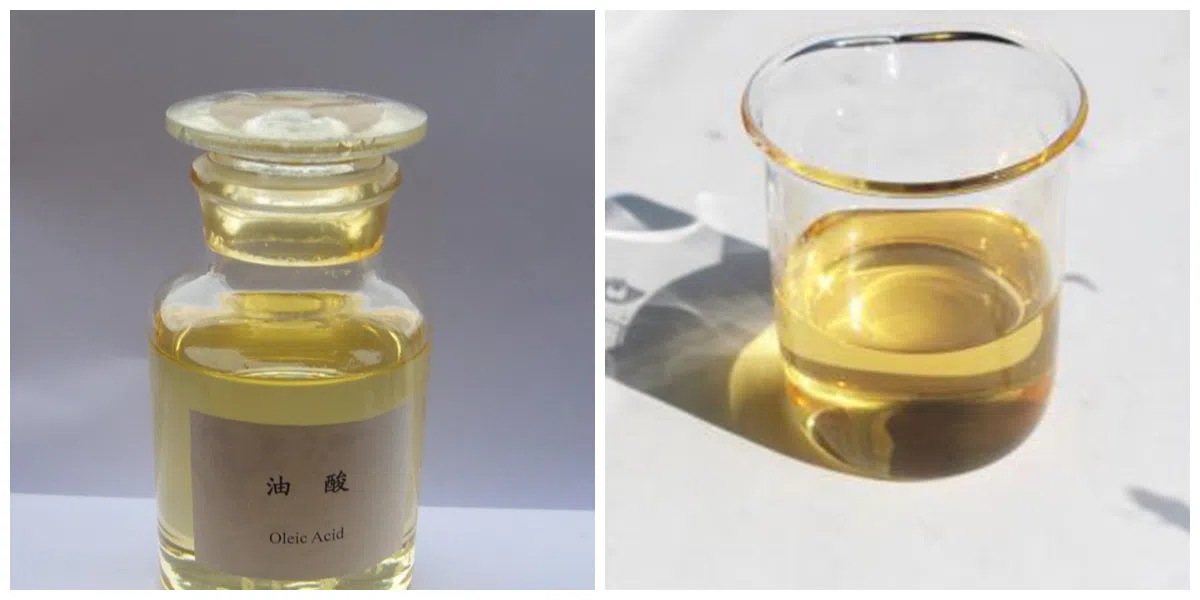
| color | Colorless to pale yellow |
| Odor | Peculiar Lard-Like |
| Odor Type | fatty |
| biological source | plant (Sunflower) |
| Water Solubility | negligible |
| Sensitive | Air Sensitive |
| Merck | 14,6828 |
| JECFA Number | 333 |
| BRN | 1726542 |
| Hydrophilic-Lipophilic Balance (HLB) | 1 |
| Dielectric constant | 2.5(20℃) |
| Stability: | Stable. Combustible. Incompatible with strong oxidizing agents, aluminium. |
| InChIKey | ZQPPMHVWECSIRJ-KTKRTIGZSA-N |
| LogP | 7.698 (est) |
| CAS DataBase Reference | 112-80-1(CAS DataBase Reference) |
| NIST Chemistry Reference | 9-Octadecenoic acid (Z)-(112-80-1) |
| EPA Substance Registry System | Oleic acid (112-80-1) |
Oleic Acid Application Scenarios
- Cosmetics & Personal Care: Used as emollient, moisturizer and penetration enhancer in creams, lotions, soaps and hair care products, improving skin softness and ingredient absorption.
- Chemical Raw Material: Acts as a key intermediate for producing oleates, azelaic acid, epoxidized plasticizers, oleamide and other downstream chemical derivatives.
- Textile Industry: Serves as softening agent and lubricant for fibers, reducing static and improving the hand feel of fabrics during spinning and finishing.
- Rubber & Plastics: Applied as internal lubricant, release agent and processing aid to boost the flowability and surface gloss of polymer products.
- Agricultural Formulations: Used as adjuvant and carrier in pesticide emulsions, helping active ingredients spread and penetrate on crop surfaces.
- Pharmaceutical Industry: Used as oily solvent, excipient and transdermal carrier in topical ointments and drug preparations.