BIS(2-Methacryloxyethyl)phosphate CAS#32435-46-4 Product Description
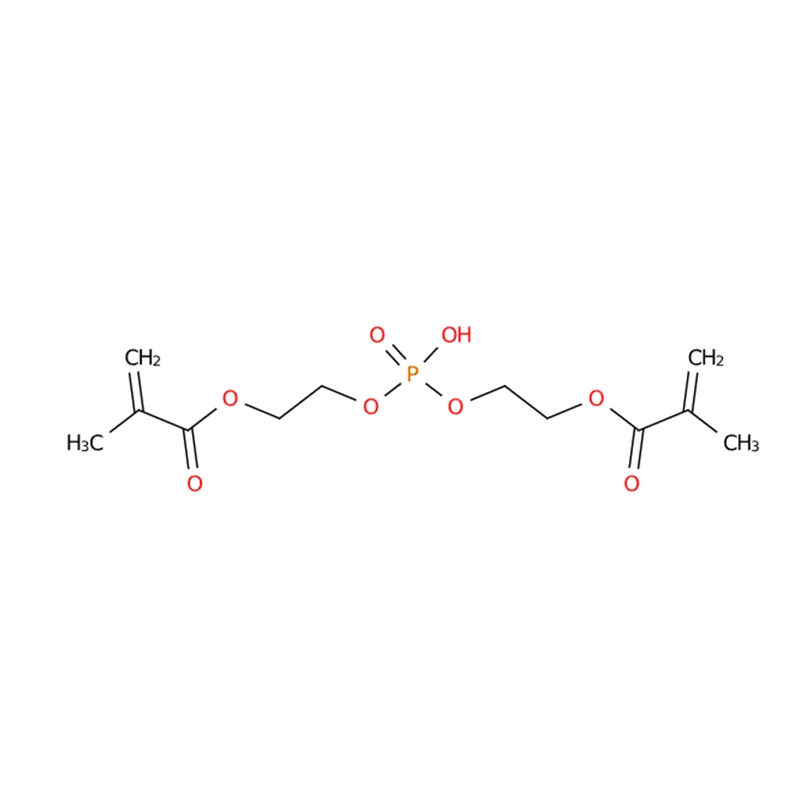
Bis(2-Methacryloxyethyl) phosphate (CAS No. 32435-46-4) is a hydrophilic, difunctional phosphate-containing monomer characterized by its molecular formula C₁₂H₁₉O₈P. Its molecular structure incorporates two reactive methacrylate functionalities and a phosphate group, providing multiple sites for chemical interaction and polymerization. This distinctive combination of functional groups contributes to its versatility in polymer synthesis and surface modification. Owing to its excellent reactivity and potential for promoting interfacial adhesion, the compound is widely employed as a functional coupling agent and adhesion promoter in dental resin formulations. In addition, it serves as an important reactive building block for the development of phosphorus-containing flame-retardant polymer systems and superabsorbent materials, offering opportunities to tailor polymer properties and expand their applications in various industrial and specialty material fields.
BIS(2-Methacryloxyethyl)phosphate CAS#32435-46-4 Chemical Properties
| Boiling point | 221 °C(lit.) |
| Density | 1.28 g/mL at 25 °C(lit.) |
| Refractive index | n20/D 1.47(lit.) |
| Fp | >230 °F |
| Storage temp | 2-8°C |
| Pka | 1.29±0.50(Predicted) |
| EPA Substance Registry System | 2-Propenoic acid, 2-methyl-, phosphinicobis(oxy-2,1-ethanediyl) ester (32435-46-4) |
BIS(2-Methacryloxyethyl)phosphate CAS#32435-46-4 Safety Information
| Hazard Codes | Xi |
| Risk Statements | 36/37/38 |
| Safety Statements | 26-36 |
| WGK Germany | 3 |
| HS Code | 29199000 |
BIS(2-Methacryloxyethyl)phosphate CAS#32435-46-4 Product Application
Dental Materials: Employed as a functional monomer in self-etching primer formulations for enamel and dentin, where its phosphate functionality facilitates interaction with dental hard tissues and contributes to improved bonding performance.
Polymer Science: Utilized as a multifunctional crosslinking agent in the preparation of superabsorbent polymers (SAPs) and phosphorus-containing flame-retardant nanocomposites. Its bifunctional methacrylate groups enable the formation of crosslinked polymer networks with tunable structural and functional properties.
Reactivity and Polymerization: Characterized by its polymerizable methacrylate functionalities, which support efficient polymer network formation and can achieve a high degree of monomer conversion under suitable polymerization conditions. Its distinctive molecular structure makes it a promising building block for advanced functional polymer materials.