
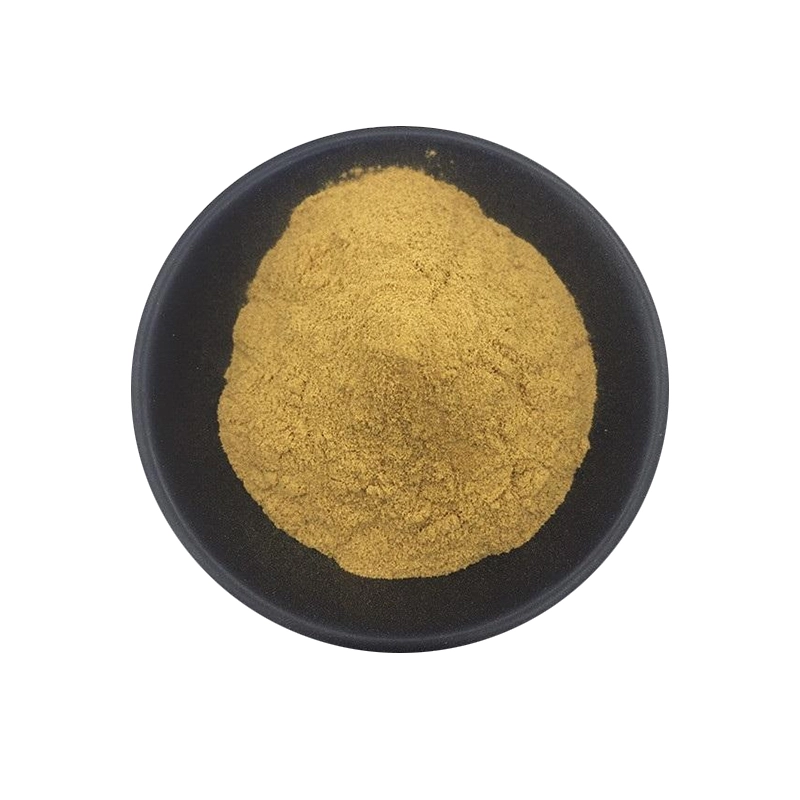
Products Description of Tannic acid CAS#1401-55-4
Tannic acid is an organic compound with molecular formula C₇₆H₅₂O₄₆. It occurs as yellow to brownish‑yellow amorphous powder. Its aqueous solution will turn blue‑black when coming into contact with iron‑salt solutions, and such color‑changing reaction can be retarded by adding sodium sulfite.
Industrially, tannic acid is widely utilised for leather tanning and blue‑ink manufacturing. Benefiting from its protein‑coagulating property, it carries out chemical treatment on raw pig and cow hides to solidify soluble proteins within animal skins. Via this procedure, raw hides, which would otherwise decay and produce unpleasant odors within several days, are converted into clean, supple and durable leather. This conversion process is referred to as leather tanning.
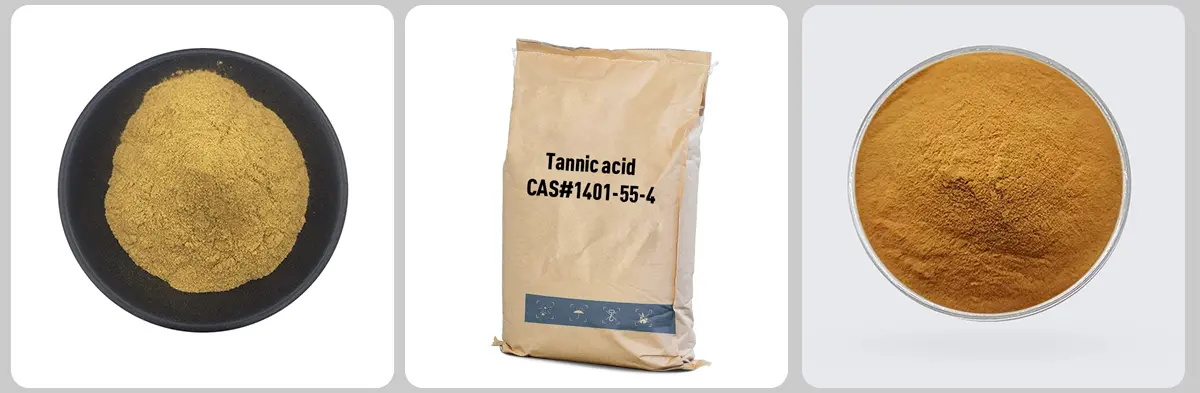
Tannic acid Chemical Properties
| Melting point | 218 °C (lit.) |
| Boiling point | 862.78°C (rough estimate) |
| density | 1.2965 (rough estimate) |
| refractive index | 1.7040 (estimate) |
| FEMA | 3042 | TANNIC ACID (QUERCUS SPP.) |
| Fp | 198°C |
| storage temp. | Storage temperature: no restrictions. |
| solubility | ethanol: soluble100mg/mL, yellow to brown |
| form | Powder/Solid |
| color | Yellow to light brown |
| PH | 3.5 (100g/l, H2O, 20°C) |
| Odor | Slight in solution, typical tannic acid |
| Water Solubility | 250 g/L (20 ºC) |
| Sensitive | Air & Light Sensitive |
| Merck | 14,9052 |
| BRN | 8186396 |
| Stability: | Stable. Incompatible with metallic salts, strong oxidizing agents, iron and other heavy metals. |
| InChIKey | LRBQNJMCXXYXIU-PPKXGCFTSA-N |
| LogP | 13.327 (est) |
| IARC | 3 (Vol. 10, Sup 7) 1987 |
| EPA Substance Registry System | Tannic acid (1401-55-4) |
Product Application of Tannic acid CAS#1401-55-4
It functions as clarifier, astringent, crude‑oil deodorant and fragrance auxiliary agent. Tannic acid finds applications in leather tanning, ink production, paper‑sizing and silk‑gluing processes, as well as boiler descaling. It also acts as textile mordant, clarifying agent for beer and wine, and coagulant for rubber manufacturing.
Its application scope further covers printing‑dyeing, metallurgy, pharmaceutical and other industrial sectors. Tannic acid features extremely low inherent toxicity. In analytical chemistry, it enables precipitation and gravimetric determination of beryllium, aluminum, gallium, indium, niobium, tantalum and zirconium; it supports colorimetric ratio determination for copper, iron, vanadium, cerium and cobalt. It works as precipitant for proteins and alkaloids, external indicator for lead titration with ammonium molybdate, and dye mordant.


