
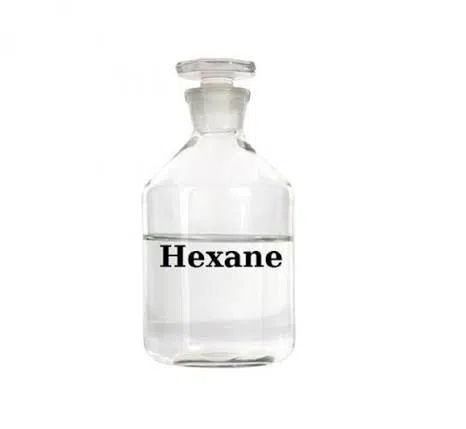
Products Description
Hexane is a highly flammable, colorless, and volatile liquid characterized by a gasoline-like odor. Its odor threshold in water is approximately 0.0064 mg/L, while the odor threshold in air ranges from 230 to 875 mg/m³. It has a molecular weight of 86.20 g/mol and a specific gravity (H₂O = 1) of 0.66. Its boiling point is 68.9°C, and its freezing/melting point is approximately −95°C. The relative vapor density (air = 1) is 3.0, and its vapor pressure reaches 124 mmHg at 20°C. The flash point is −21.6°C (closed cup), while the autoignition temperature is 225°C. Its explosive limits range from 1.1% (LEL) to 7.5% (UEL). According to the NFPA 704M hazard classification system, hexane has a health hazard rating of 1, a flammability rating of 3, and a reactivity rating of 0. It is practically insoluble in water, with a reported solubility of approximately 0.002%.
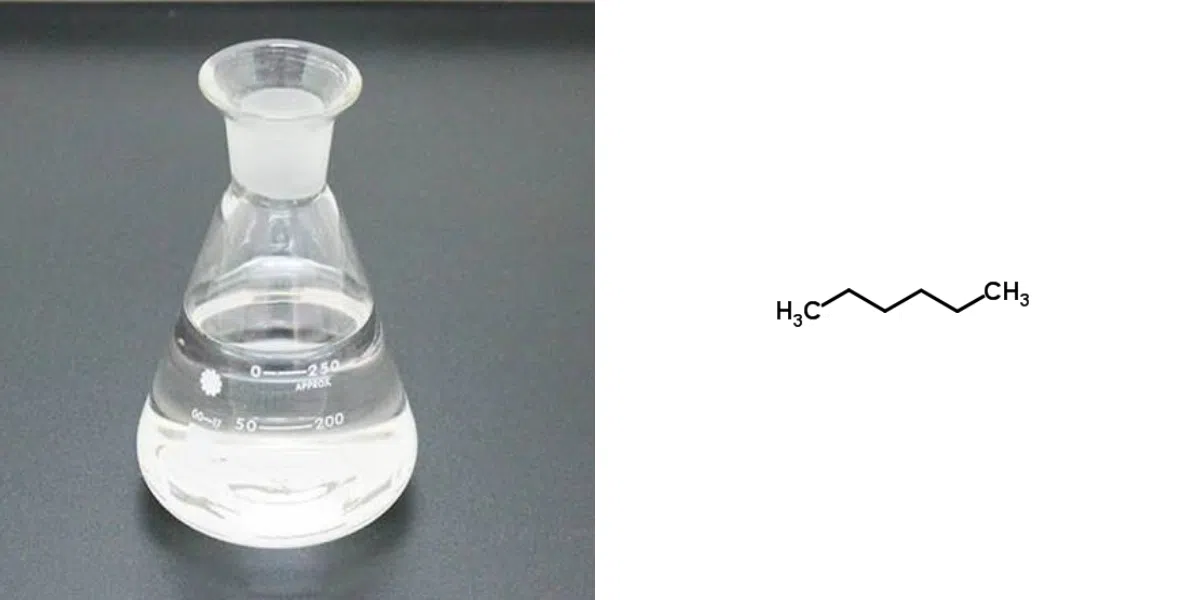
Chemical Properties
Melting point | -95 °C |
Boiling point | 68.95 °C(lit.) |
density | 0.659 g/mL at 25 °C(lit.) |
vapor density | 3.5 (vs air) |
vapor pressure | 40 mm Hg ( 20 °C) |
refractive index | n20/D |
Fp | 30 °F |
storage temp. | Store at +5°C to +30°C. |
solubility | Very soluble in ethanol, ethyl ether and chloroform. |
form | Liquid |
pka | >14 (Schwarzenbach et al., 1993) |
color | Colorless |
Specific Gravity | 0.660 (20/4℃) |
Odor | Mild gasoline-like odor detectable at 65 to 248 ppm |
Relative polarity | 0.009 |
explosive limit | 1.0-8.1%(V) |
Odor Threshold | 1.5ppm |
Water Solubility | insoluble |
λmax | λ: 200 nm Amax: ≤0.70 |
Merck | 14,4694 |
BRN | 1730733 |
Henry's Law Constant | 0.238, 0.413, 0.883, 0.768, and 1.56 at 10, 15, 20, 25, and 30 °C, respectively (EPICS, Ashworth et al., 1988) |
Dielectric constant | 2.0(-90℃) |
Exposure limits | TLV-TWA 50 ppm (~175 mg/m3) (ACGIH), 500 ppm (~1750 mg/m3) (OSHA); IDLH 5000 ppm (NIOSH). |
Stability: | Stable. Incompatible with oxidizing agents, chlorine, fluorine, magnesium perchlorate. Highly flammable. Readily forms explosive mixtures with air. Note low flash point. |
InChIKey | VLKZOEOYAKHREP-UHFFFAOYSA-N |
LogP | 4 at 20℃ and pH7 |
CAS DataBase Reference | 110-54-3(CAS DataBase Reference) |
NIST Chemistry Reference | Hexane(110-54-3) |
EPA Substance Registry System | Hexane (110-54-3) |
Safety Information
Hazard Codes | F,Xn,N |
Risk Statements | 11-38-50/53-65-67-62-51/53-48/20-36/37/38 |
Safety Statements | 9-16-29-33-60-61-62-36/37-45-36/37/39-53-26 |
RIDADR | UN 3295 3/PG 2 |
OEB | A |
OEL | TWA: 50 ppm (180 mg/m3) |
WGK Germany | 3 |
RTECS | MN9275000 |
F | 3-10 |
Autoignition Temperature | 225 °C |
TSCA | Yes |
HazardClass | 3 |
PackingGroup | II |
HS Code | 29011000 |
Hazardous Substances Data | 110-54-3(Hazardous Substances Data) |
Toxicity | LC50 (4 hr) in mice by inhalation: 48000 ppm; LD50 orally in rats: 32.0 g/kg (Couri, Milks) |
IDLA | 1,100 ppm [10% LEL] |
Product Applications
N-Hexane is a major component of petroleum ether, gasoline, and rubber solvents. It is widely used as an industrial solvent for adhesives, vegetable oils, and various analytical applications, as well as for the denaturation of alcohol. Due to its high purity and favorable solvent properties, it is also suitable for applications in high-performance liquid chromatography (HPLC), spectrophotometry, and environmental analysis. Additional uses include the determination of mineral refractive indices, as a filling liquid in certain thermometers as an alternative to mercury (often with blue or purple dye added for visibility), and as an extraction solvent in oilseed processing for the recovery of vegetable oils.


