Product Description
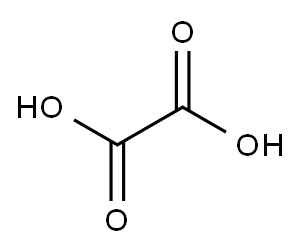
Oxalic acid (chemical formula H₂C₂O₄) is an organic compound and a moderately strong acid. It occurs naturally as a metabolite in plants, animals and fungi, and exists abundantly in over 100 plant species such as spinach, amaranth, beet, purslane, taro, sweet potato and rhubarb.
It binds readily with calcium ions to form calcium oxalate, which may lead to kidney stones and reduce the absorption of mineral nutrients in the human body. Its anhydride is carbon trioxide.
Chemical Properties
| Melting point | 189.5 °C (dec.)(lit.) |
| Boiling point | 365.1°C (estimate) |
| density | 0.99 g/mL at 25 °C |
| bulk density | 750kg/m3 |
| vapor density | 4.4 (vs air) |
| vapor pressure | <0.01 mm Hg ( 20 °C) |
| refractive index | 1.4261 (estimate) |
| Fp | 101-157°C |
| storage temp. | Store below +30°C. |
| solubility | water: soluble108g/L at 25°C |
| form | Liquid |
| pka | 1.23(at 25℃) |
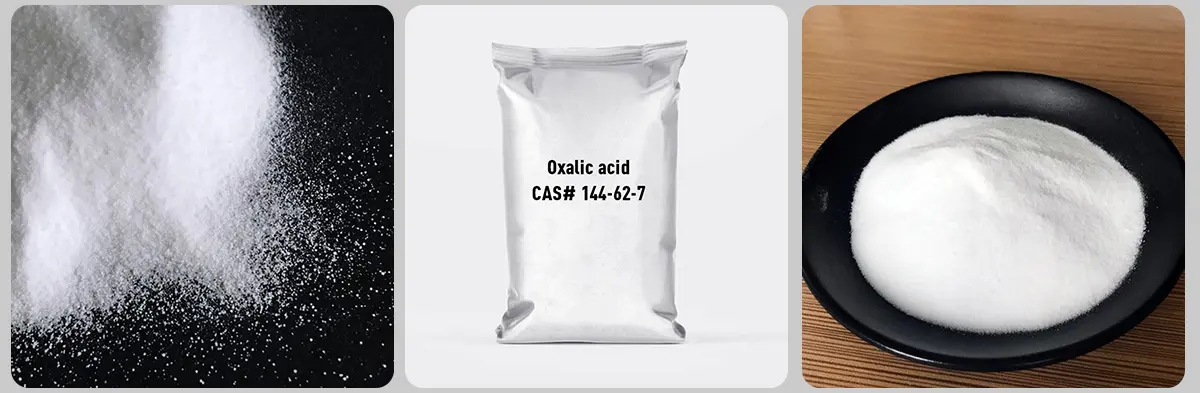
| color | White |
| PH Range | 6 - 8 at 25 °C |
| PH | 3(1 mM solution);2.09(10 mM solution);1.31(100 mM solution); |
| Odor | odorless |
| Water Solubility | 90 g/L (20 ºC) |
| Sublimation | 101-157 ºC |
| Merck | 14,6911 |
| BRN | 385686 |
| Henry's Law Constant | 1.43 at pH 4 (quoted, Gaffney et al., 1987) |
| Exposure limits | NIOSH REL: TWA 1, STEL 2, IDLH 500; OSHA PEL: TWA 1; ACGIH TLV: TWA 1, STEL 2 (adopted). |
| Stability: | Stable, but moisture sensitive. Incompatible with metals. |
| InChIKey | MUBZPKHOEPUJKR-UHFFFAOYSA-N |
| LogP | -1.7 at 23℃ |
| CAS DataBase Reference | 144-62-7(CAS DataBase Reference) |
| NIST Chemistry Reference | Oxalic acid(144-62-7) |
| EPA Substance Registry System | Oxalic acid (144-62-7) |
Safety Information
| Hazard Codes | Xn |
| Risk Statements | 21/22-63-34-41 |
| Safety Statements | 24/25-23-36/37/39-27-26-39-37-36-36/37 |
| RIDADR | UN 3261 8/PG 3 |
| OEB | C |
| OEL | TWA: 1 mg/m3, STEL: 2 mg/m3 |
| WGK Germany | 1 |
| RTECS | RO2450000 |
| TSCA | Yes |
| HazardClass | 8 |
| PackingGroup | III |
| HS Code | 29171110 |
| Hazardous Substances Data | 144-62-7(Hazardous Substances Data) |
| Toxicity | LD50 orally in Rabbit: 375 mg/kg |
| IDLA | 500 mg/m3 |
Product Application
It is widely used as a reducing and bleaching agent in various industrial processes and also serves as a mordant in the textile printing and dyeing industry to improve dye fixation and color uniformity. In addition, it plays an important role in the refining and purification of rare metals. It is also used as a chemical intermediate in the synthesis of various oxalate salts, oxalic acid derivatives, and oxalamides, which have applications in chemical manufacturing and other industrial processes.