
Products Description of Imidazole CAS#288-32-4
Categorized within the diazole family, imidazole (𝐶3𝐻4𝑁2) is a five-membered aromatic heterocycle containing two non-adjacent nitrogen atoms. The lone pair on the N-1 nitrogen participates in ring conjugation, decreasing local electron density and rendering the attached hydrogen easily ionizable as a proton. Displaying dual acidic and basic properties that blend the chemical traits of pyridine and pyrrole, it readily forms salts with strong bases. In biological systems, the imidazole ring serves as a vital component of histidine, functioning in acyl-transfer and enzyme catalysis, while its numerous derivatives—including DNA- and hemoglobin-related structures—hold immense significance in research and industry.
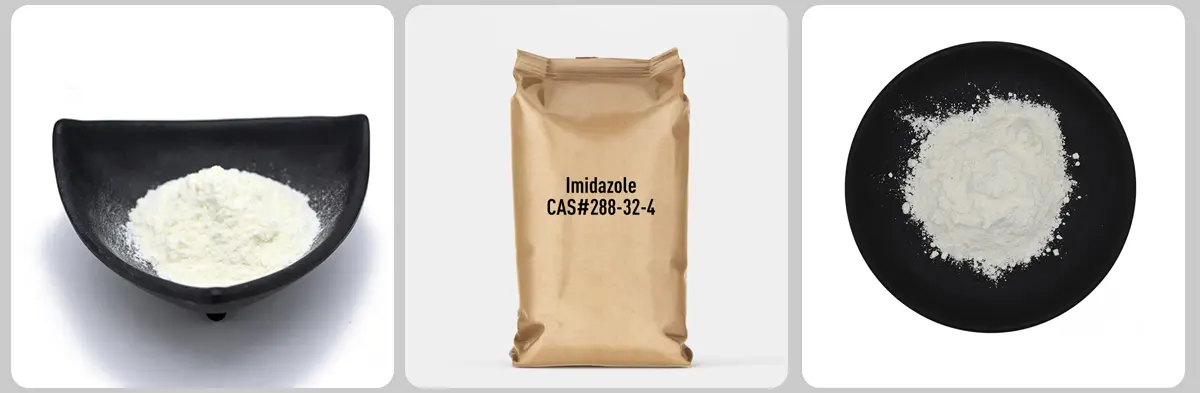
| Melting point | 88-91 °C(lit.) |
| Boiling point | 256 °C(lit.) |
| density | 1.01 g/mL at 20 °C |
| vapor pressure | <1 mm Hg ( 20 °C) |
| refractive index | 1.4801 |
| Fp | 293 °F |
| storage temp. | Store below +30°C. |
| solubility | H2O: 0.1 M at 20 °C, clear, colorless |
| pka | 6.953(at 25℃) |
| form | crystalline |
| color | white |
| Specific Gravity | 1.03 |
| Odor | Amine like |
| PH Range | 9.5 - 11 |
| PH | 9.5-11.0 (25℃, 50mg/mL in H2O) |
| Water Solubility | 633 g/L (20 ºC) |
| Sensitive | Hygroscopic |
| λmax | λ: 260 nm Amax: 0.10 |
| λ: 280 nm Amax: 0.10 | |
| Merck | 144912 |
| BRN | 103853 |
| Dielectric constant | 23.0(Ambient) |
| Stability: | Stable. Incompatible with acids, strong oxidizing agents. Protect from moisture. |
| InChIKey | RAXXELZNTBOGNW-UHFFFAOYSA-N |
| LogP | -0.02 at 25℃ |
| CAS DataBase Reference | 288-32-4(CAS DataBase Reference) |
| NIST Chemistry Reference | 1H-Imidazole(288-32-4) |
| EPA Substance Registry System | Imidazole (288-32-4) |
| Hazard Codes | C,Xi,T |
| Risk Statements | 36/38-63-34-22-20/21/22-61 |
| Safety Statements | 26-36/37/39-45-22-36-27-53 |
| RIDADR | UN 2923 8/PG 3 |
| WGK Germany | 1 |
| RTECS | NI3325000 |
| Autoignition Temperature | 480 °C |
| TSCA | Yes |
| HazardClass | 8 |
| PackingGroup | III |
| HS Code | 29332990 |
| Hazardous Substances Data | 288-32-4(Hazardous Substances Data) |
| Toxicity | LD50 in mice (mg/kg): 610 i.p.; 1880 orally (Nishie) |

As an essential reagent with CAS# 288-32-4, imidazole exhibits slightly higher alkalinity than pyrazole and easily creates stable salts, such as nitrates and picrates. A primary application lies in purifying His-tagged proteins via immobilized metal affinity chromatography (IMAC). Throughout this workflow, fusion proteins bearing a histidine tag bind specifically to nickel ions anchored on the matrix; subsequent application of an imidazole-rich buffer displaces the tagged target from the nickel sites, releasing the highly purified protein for collection.