Products Description
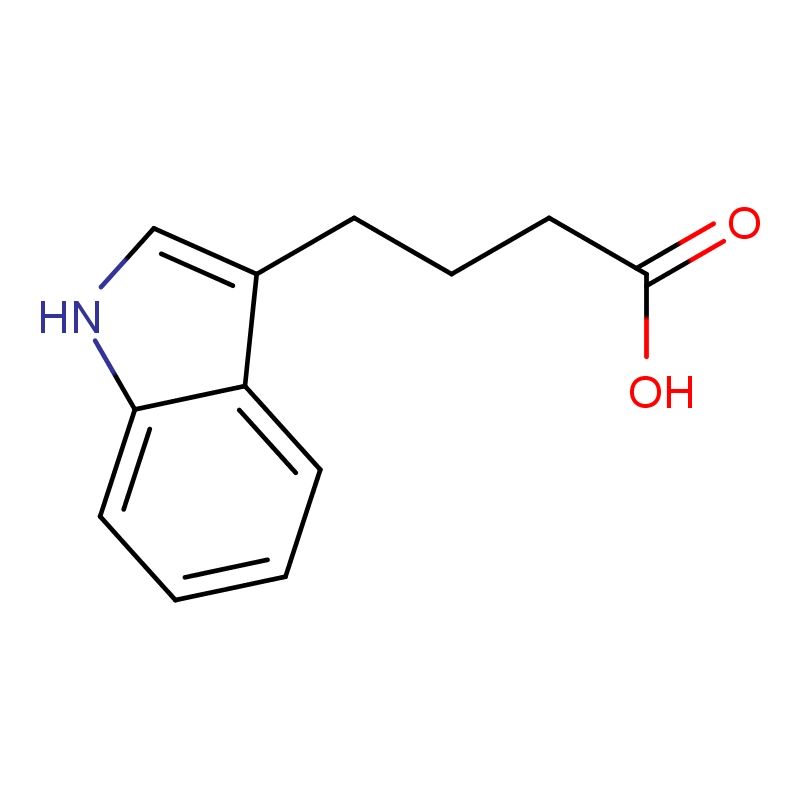
Indole-3-butyric acid is a typical indole-3-yl carboxylic acid, where butanoic acid is covalently bonded to the 3-position of a 1H-indole ring. As a naturally occurring auxin, it functions as a core plant hormone and endogenous plant metabolite, regulating cell division and differentiation in plant tissues. It is structurally derived from butyric acid, and exists as the conjugate acid of indole-3-butyrate salt, with better metabolic stability than natural indole-3-acetic acid in plant bodies, making it a highly efficient rooting-promoting agent widely used in agricultural propagation.
Chemical Properties
| Melting point | 124-125.5 °C(lit.) |
| Boiling point | 341.55°C (rough estimate) |
| density | 1.1255 (rough estimate) |
| bulk density | 360kg/m3 |
| refractive index | 1.5440 (estimate) |
| storage temp. | 2-8°C |
| solubility | DMF: 25 mg/mL; DMSO: 25 mg/mL; Ethanol: 25 mg/mL; PBS (pH 7.2): 0.1 mg/mL |
| pka | 4.83±0.10(Predicted) |
| form | Liquid |
| color | Clear colorless to pale yellow |
| Water Solubility | Soluble in water(0.25g/L). |
| Sensitive | Air Sensitive |
| Merck | 14,4965 |
| BRN | 171120 |
| Stability: | Stable. Incompatible with strong oxidizing agents. Light sensitive. |
| InChIKey | JTEDVYBZBROSJT-UHFFFAOYSA-N |
| LogP | 2.300 |
| CAS DataBase Reference | 133-32-4(CAS DataBase Reference) |
| EPA Substance Registry System | Indole-3-butyric acid (133-32-4) |
Safety Information
| Hazard Codes | T,Xi |
| Risk Statements | 25-36/37/38 |
| Safety Statements | 26-36-45-38-36/37/39-28A |
| RIDADR | UN 2811 6.1/PG 3 |
| WGK Germany | 3 |
| RTECS | NL5250000 |
| F | 8-10-23 |
| Hazard Note | Irritant |
| TSCA | T |
| HazardClass | 6.1 |
| PackingGroup | III |
| HS Code | 29339990 |
| Hazardous Substances Data | 133-32-4(Hazardous Substances Data) |
| Toxicity | LD50 i.p. in mice: 100 mg/kg (Anderson) |
Product Application
Indole‑3‑butyric acid (IBA) is a versatile indole‑type auxin plant growth regulator, widely celebrated as a highly efficient rooting stimulant. It powerfully triggers adventitious root development for cuttings of both herbaceous plants and woody ornamentals, greatly accelerating rooting and boosting the survival rate of seedlings. Besides its rooting function, IBA can also be applied to fruit crops to reduce blossom and fruit drop, thereby enhancing the fruit‑setting rate and stabilizing yield.