
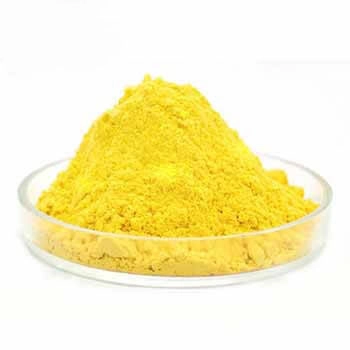
Bismuth trioxide CAS#1304-76-3
Bismuth trioxide, also simply called bismuth oxide, exists in multiple crystalline polymorphs including α‑type, β‑type and δ‑type.
α‑Bi₂O₃ appears as yellow monoclinic crystals with relative density of 8.9 and melting point at 825 °C. It is soluble in mineral acids, but insoluble in water and alkali. β‑Bi₂O₃ is bright‑yellow to orange tetragonal crystal, with relative density 8.55 and melting point of 860 °C. It dissolves in acid and is insoluble in water, and can be readily reduced to metallic bismuth by hydrogen or hydrocarbon gases. δ‑Bi₂O₃ adopts a special cubic fluorite‑type crystal structure. One‑quarter of oxygen‑ion lattice sites are vacant, which gives the material extremely high oxygen‑ion conductivity.
Bismuth trioxide can be prepared by thermal decomposition of bismuth nitrate. It can be reduced by carbon and hydrogen at high temperature. This product is widely applied for manufacturing metallic bismuth, industrial catalysts and bismuth‑oxide‑based superconductor materials.
Bismuth Trioxide Chemical Properties
| Melting point | 825 °C |
| Boiling point | 1890°C |
| density | 8.9 |
| Fp | 1890°C |
| storage temp. | Store at +5°C to +30°C. |
| solubility | 0.006g/l practically insoluble |
| form | powder |
| color | Yellow |
| Specific Gravity | 8.9 |
| Odor | Odorless |
| Water Solubility | INSOLUBLE |
| Merck | 14,1273 |
| Stability: | Stable. |
| InChIKey | KOCGCHBRHPOCBW-UHFFFAOYSA-N |
| CAS DataBase Reference | 1304-76-3(CAS DataBase Reference) |
| NIST Chemistry Reference | bismuth(III) oxide(1304-76-3) |
| EPA Substance Registry System | Bismuth trioxide (1304-76-3) |


