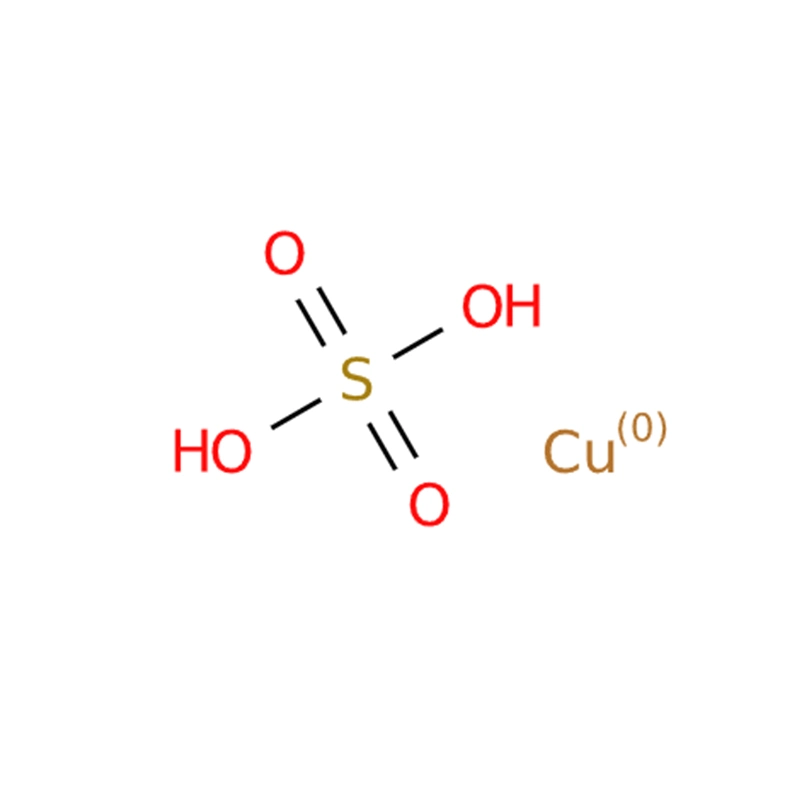
Products Description of Copper(II) Sulfate CAS#7758-98-7
Copper sulfate is an inorganic compound widely used in the inorganic chemical industry as a raw material for the production of other copper salts, including cuprous chloride, cupric chloride, copper pyrophosphate, cuprous oxide, copper acetate, copper carbonate, and others.
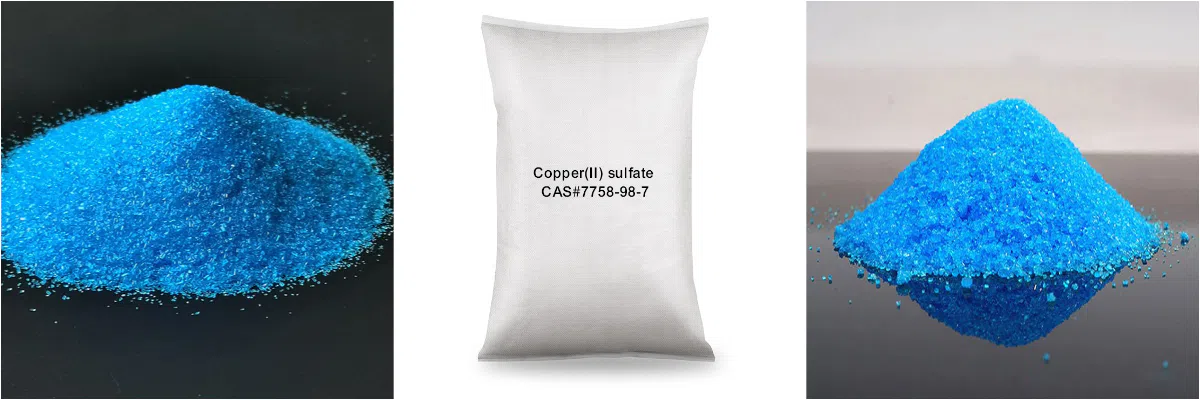
Copper sulfate commonly occurs in crystalline form. Anhydrous copper sulfate is a white crystalline powder, although it may appear light gray-green due to impurities. It is a soluble copper salt with a relative density of 3.603 and a water solubility of approximately 23.05 g at 25°C. It is insoluble in ethanol and ether but readily soluble in water, producing a characteristic blue aqueous solution. Copper sulfate is a salt of a strong acid and a weak base, and its hydrolyzed solution is weakly acidic and exhibits strong pathogen-killing properties.
Copper sulfate is widely used in aquaculture for the prevention and treatment of fish diseases. When its solution is concentrated and crystallized, blue crystals of copper sulfate pentahydrate are obtained, commonly known as gallstone, stone gall, copper sulfate, or blue vitriol. Copper sulfate pentahydrate is toxic, odorless, and has a metallic, astringent taste.
Copper sulfate is highly stable under normal temperature and pressure conditions. It does not readily deliquesce but gradually weathers in dry air. When heated to 45°C, it loses two molecules of crystal water; at 110°C, it loses four molecules of crystal water; and at 150°C, it loses all of its crystal water and becomes anhydrous copper sulfate. The anhydrous compound can absorb water and be converted back into the hydrated form. At approximately 650°C, copper sulfate decomposes into copper oxide and sulfur trioxide.
The blue color of copper sulfate aqueous solutions is caused by hydrated copper ions. This characteristic is commonly used in laboratory applications to test for the presence of water. In practical production and agricultural applications, copper sulfate is used in copper refining and can be mixed with slaked lime to prepare Bordeaux mixture, a widely used pesticide.
The copper ions in copper sulfate can disrupt the three-dimensional structure of proteins and cause protein denaturation. In protein concentration determination, an alkaline solution is often added to the protein sample, followed by the addition of copper sulfate solution. The solution then turns purple, and this reaction is known as the biuret reaction.
Copper sulfate is a heavy metal salt and is toxic. The stated lethal dose for adults is 0.9 g/kg. In the event of accidental ingestion, the source recommends consuming large amounts of protein-rich foods such as milk and egg white, or using calcium disodium EDTA for detoxification.
Product Application of Copper(II) Sulfate CAS#7758-98-7
Agriculture: Fungicide raw material and component of Bordeaux mixture; trace-element copper fertilizer.
Electroplating: Copper source in plating baths.
Mining: Flotation reagent and mineral processing.
Water Treatment: Algae control in ponds and reservoirs.
Animal Feed: Feed-grade trace mineral (per limits).
Analytical Chemistry: Reagent and laboratory standard.