
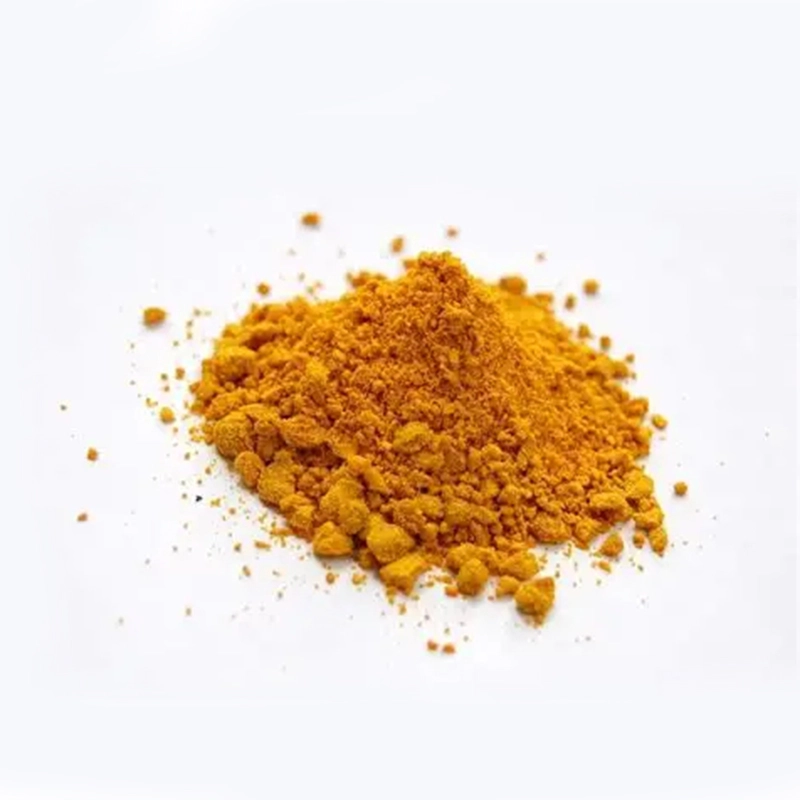
Ferric Chloride CAS#10025-77-1
Ferric chloride, also known as iron(III) chloride, boasts diverse application scenarios. Industrially, it serves for sewage treatment and potable water purification, including arsenic removal. It acts as a leaching agent in chloride hydrometallurgy. In PCB production, it etches copper via a two-step redox process, sequentially generating copper(I) chloride and copper(II) chloride. It also functions as a catalyst for synthesizing ethylene dichloride from ethylene and chlorine. In lab settings, it is widely applied as a Lewis acid to catalyze aromatic chlorination and Friedel–Crafts reactions.
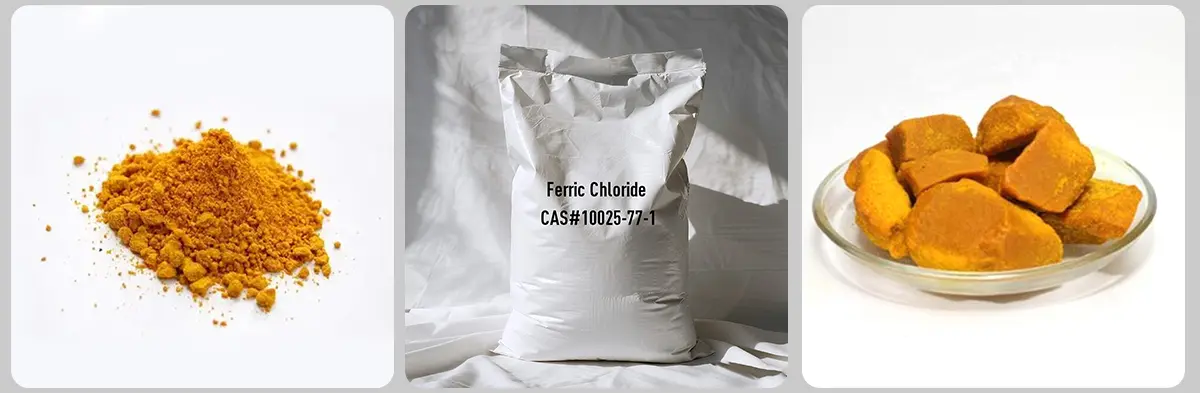
Ferric Chloride Chemical Properties
| Melting point | 37 °C(lit.) |
| Boiling point | 280-285 °C(lit.) |
| Density | 1,82 g/cm3 |
| Bulk density | 600-1200kg/m3 |
| Vapor pressure | 1 mm Hg ( 194 °C) |
| Fp | 280-285°C |
| Storage temp | 2-8°C |
| Solubility | 920g/l |
| Form | Purified lumps |
| Color | Yellow-brown lumps |
| Specific Gravity | 1.82 |
| PH | 1.8 (10g/l, H2O, 25℃) |
| Water Solubility | 920 g/L (20 ºC) |
| Sensitive | Hygroscopic |
| Merck | 14,4019 |
| Exposure limits | ACGIH: TWA 1 mg/m3 NIOSH: TWA 1 mg/m3 |
| Stability | Stable. Incompatible with strong oxidizing agents. Forms explosive mixtures with sodium and potassium. Hygroscopic. |
| CAS DataBase Reference | 10025-77-1(CAS DataBase Reference) |
Product Application of Ferric Chloride
Ferric chloride finds broad applications in industrial wastewater treatment, chloride hydrometallurgy (such as the Silgarin process for silicon manufacturing), and drinking water purification. It is also utilized to produce PVC precursors and copper components for printed circuit boards. Besides, it acts as an etchant for photoengraving and photography, a mordant in textile dyeing and printing, and a test reagent in Trinder spot assays to identify phenols, phenolic derivatives, gamma-hydroxybutyric acids and salicylic acids.


