
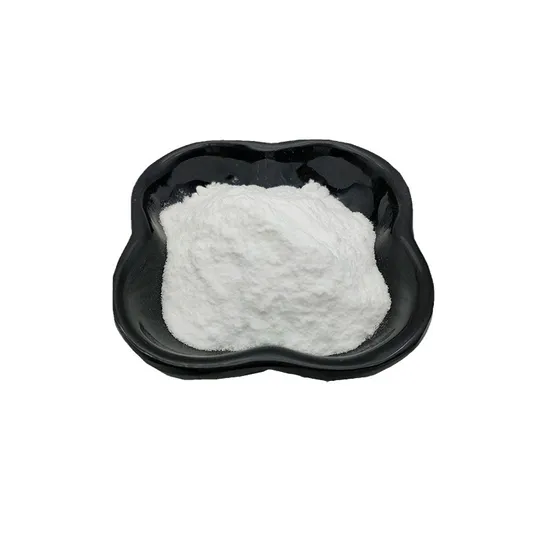
Potassium Titanate CAS#12030-97-6
Potassium titanate is an inorganic white‑colored solid substance with the chemical formula K₂TiO₃. It frequently co‑exists with fibrous titanate crystal phases such as K₂Ti₆O₁₃ (potassium hexatitanate whisker). This functional ceramic material is distinguished by outstanding thermal stability and favorable friction‑modifying performance.
It occurs as white solid powder with a relative density of 3.1 and a melting point of around 1515 °C. Upon contact with water, it undergoes hydrolysis and generates a strongly alkaline aqueous solution.
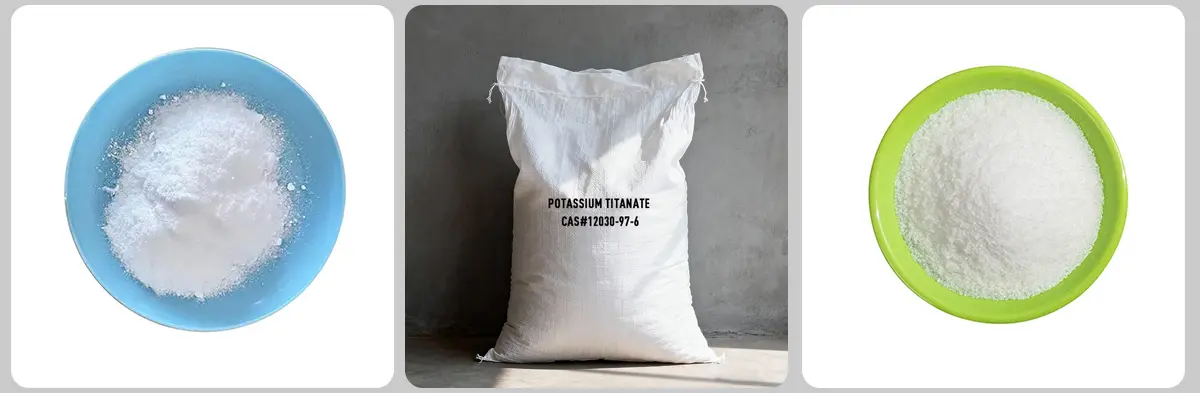
POTASSIUM TITANATE Chemical Properties
| Melting point | 1615°C |
| density | 3.1 |
| solubility | reacts with H2O |
| form | Powder |
| color | white orthorhombic crystals, crystalline |
| Water Solubility | hydrolyzes in H2O to give a strongly alkaline solution [HAW93] |
| CAS DataBase Reference | 12030-97-6(CAS DataBase Reference) |
| EPA Substance Registry System | Potassium titanium oxide (K2TiO3) (12030-97-6) |
| Safety Statements | 22 |
| WGK Germany | 3 |
| TSCA | Yes |
Product Application of POTASSIUM TITANATE CAS#12030-97-6
Potassium titanate is broadly adopted in the welding electrode sector as a flux and analytical reagent. It is well suited for manufacturing low‑hydrogen welding rods, AC/DC welding electrodes and stainless steel welding electrodes.
It also finds applications in thermal insulation materials, electrical insulation substrates, catalyst supports and filter media. When applied in friction materials, potassium titanate delivers obvious advantages over asbestos. It can reduce friction force by roughly 50% and cut wear loss by about 32%, making it ideal for brake linings, clutch plates and other friction components.
Surface modification with Sb/SnO₂ can endow potassium titanate with conductive properties. The treated product can act as a conductive filler or be compounded with plastics to manufacture conductive composite materials. Furthermore, it functions as an ion exchange medium and adsorbent.


