
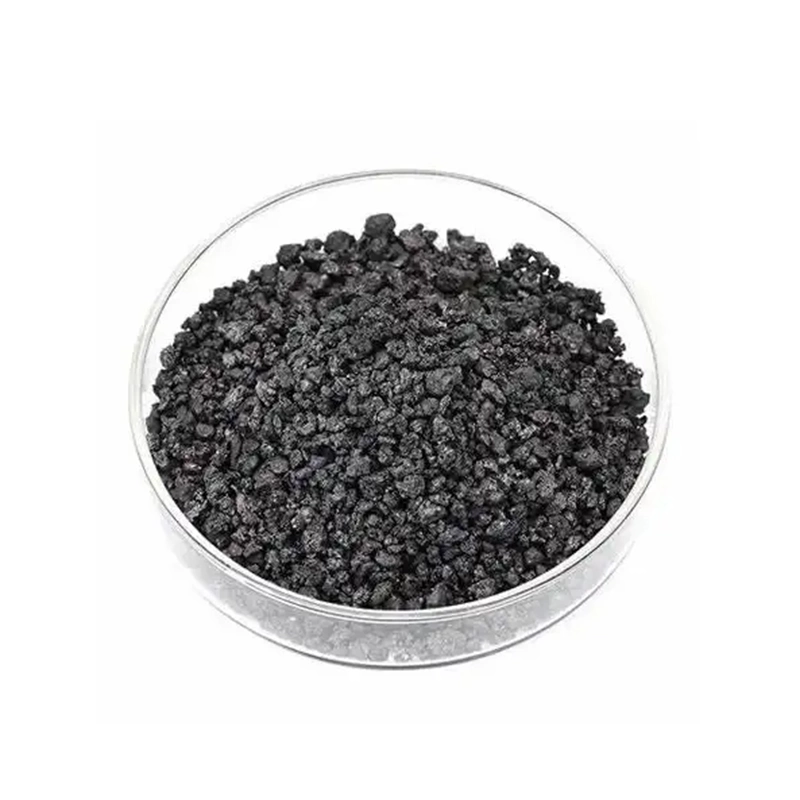
Silicon carbide CAS#409-21-2
Silicon carbide, also referred to as carborundum, is a ceramic compound composed of silicon and carbon. Naturally, it occurs only as the scarce mineral moissanite. Starting from 1893, silicon carbide powder has been widely adopted as an abrasive material. When sintered, the powder forms rigid silicon carbide ceramic grains. These grains are applied in components demanding outstanding wear resistance, including vehicle brake pads, clutches and ballistic vests. Additionally, the material has found applications in electronics, such as early radio detectors and light-emitting diodes. At present, silicon carbide serves as a key material for high-temperature and high-voltage semiconductor production.
Silicon Carbide Chemical Properties
| Melting point | 2700 °C (lit.) |
| density | 3.22 g/mL at 25 °C (lit.) |
| refractive index | 2.65 |
| solubility | Soluble in molten sodium hydroxide, potassium hydroxide and in molten iron. |
| form | nanopowder |
| color | Green |
| Specific Gravity | 3.22 |
| Resistivity | 107–200 (ρ/μΩ.cm) |
| Water Solubility | Soluble in molten alkalis (NaOH, KOH) and molten iron. Insoluble in water. |
| Crystal Structure | Cubic, Sphalerite Structure - Space Group F(-4)3m |
| Hydrolytic Sensitivity | 1: no significant reaction with aqueous systems |
| Merck | 148492 |
| Exposure limits | ACGIH: TWA 10 mg/m3; TWA 3 mg/m3; TWA 0.1 fiber/cm3 |
| OSHA: TWA 15 mg/m3; TWA 5 mg/m3 | |
| NIOSH: TWA 10 mg/m3; TWA 5 mg/m3 | |
| Stability: | Stability |
| InChIKey | HBMJWWWQQXIZIP-UHFFFAOYSA-N |
| IARC | 2A (Vol. 111) 2017 |
| NIST Chemistry Reference | Silicon monocarbide(409-21-2) |
| EPA Substance Registry System | Silicon carbide (409-21-2) |
| Hazard Codes | Xi |
| Risk Statements | 36/37/38 |
| Safety Statements | 26-36 |
| OEB | B |
| OEL | TWA: 10 mg/m3 (total) |
| WGK Germany | 3 |
| RTECS | VW0450000 |
| TSCA | Yes |
| HS Code | 28492000 |
| Hazardous Substances Data | 409-21-2(Hazardous Substances Data) |
Product Application of Silicon carbide CAS#409-21-2
Boasting great thermal stability, high strength, excellent thermal conductivity and other special properties, silicon carbide is commonly used in nuclear energy materials, chemical equipment, high-temperature processing, heating elements and resistors. It is also a popular choice for abrasives, grinding tools, premium refractory materials and fine ceramics.


