
Product Overview
3,5-Di-tert-butylsalicylic Acid, CAS 19715-19-6, also known as 3,5-Bis-tert-butylsalicylic Acid or DTBS, is an alkyl-substituted aromatic hydroxycarboxylic acid. It has a molecular formula of C₁₅H₂₂O₃ and a molecular weight of approximately 250.33 g/mol. The product is generally supplied as a white to off-white or beige crystalline powder, with a melting point of approximately 157–162°C.
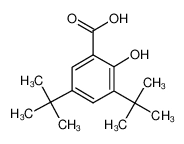
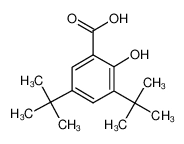
Its molecular structure consists of a salicylic acid framework containing two tert-butyl groups at the 3- and 5-positions of the aromatic ring. The molecule incorporates both a phenolic hydroxyl group and a carboxylic acid group, providing useful chemical functionality for further organic transformations.
3,5-Di-tert-butylsalicylic Acid is mainly used as a specialty organic intermediate and research chemical. Its functional groups allow it to participate in selected esterification, amidation and other chemical modification reactions. The sterically bulky tert-butyl substituents also influence its molecular properties and chemical reactivity.
3,5-Bis-tert-butylsalicylic acid Chemical Properties
Melting point | 157-162 °C (lit.) |
Boiling point | 335.6±42.0 °C(Predicted) |
density | 1.070±0.06 g/cm3(Predicted) |
Fp | 179 °C |
storage temp. | Inert atmosphere,Room Temperature |
solubility | |
form | Powder |
pka | 3.34±0.14(Predicted) |
color | Off-white to beige |
InChI | InChI=1S/C15H22O3/c1-14(2,3)9-7-10(13(17)18)12(16)11(8-9)15(4,5)6/h7-8,16H,1-6H3,(H,17,18) |
InChIKey | ZWQBZEFLFSFEOS-UHFFFAOYSA-N |
SMILES | C(O)(=O)C1=CC(C(C)(C)C)=CC(C(C)(C)C)=C1O |
CAS DataBase Reference | 19715-19-6(CAS DataBase Reference) |
EPA Substance Registry System | Benzoic acid, 3,5-bis(1,1-dimethylethyl)-2-hydroxy- (19715-19-6) |
Safety Information
Hazard Codes | Xi |
Risk Statements | 36/37/38 |
Safety Statements | 26-36 |
WGK Germany | 3 |
TSCA | Yes |
HS Code | 29182900 |
Main Applications
Organic Synthesis: Used as a functional aromatic intermediate in specialty chemical reactions.
Fine Chemical Manufacturing: Serves as a building block for producing substituted aromatic compounds.
Ester Synthesis: Used in selected esterification reactions through its carboxylic acid group.
Amide Synthesis: Provides a carboxylic acid functionality for selected amidation processes.
Chemical Research: Applied in laboratory research involving substituted salicylic acid derivatives.
Specialty Materials: Used in the development of functional organic compounds.
Chemical Modification: Supports further derivatization through its hydroxyl and carboxyl groups.


