
Products Description
Product Name: | Soy protein isolate |
Synonyms: | HYDROLYSEDSOYA-BEANPROTEIN;SOYPROTEINISOLATEETHANOLWASHED;TEXTUREDSOYPROTEIN;ISOLATEDSOYPROTEINS;Isolated soya protein;The soybeanprotein isolate;Soy Protein Concentrate/Textured/Isolate;SOY PROTEIN ISOLATE |
CAS: | 9010-10-0 |
MF: | C13H10N2 |
MW: | 194.2319 |
EINECS: | 232-720-8 |
Product Categories: | starch |
Mol File: | 9010-10-0.mol |
Chemical Properties
Melting point | 140 °C |
density | 1.3 g/cm3 |
refractive index | 1.46 |
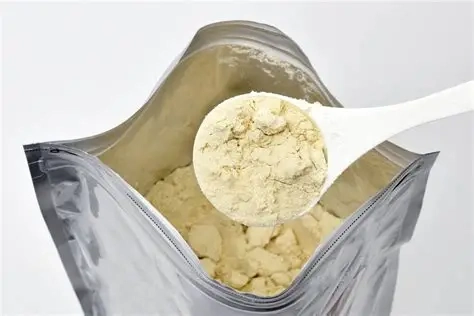
form | Light yellow powder |
Major Application | food and beverages |
Cosmetics Ingredients Functions | SURFACTANT - EMULSIFYING |
InChI | InChI=1S/C13H10N2/c14-10-12(11-6-2-1-3-7-11)13-8-4-5-9-15-13/h1-9,12H |
InChIKey | CAXNYFPECZCGFK-UHFFFAOYSA-N |
SMILES | C(#N)C(C1=CC=CC=C1)C1=NC=CC=C1 |
EPA Substance Registry System | Proteins, soybean (9010-10-0) |
Safety Information
WGK Germany | WGK 3 |
TSCA | TSCA listed |
Storage Class | 11 - Combustible Solids |
Product Applications
Soy protein is derived from soybeans and contains all essential amino acids. It is commonly available in three forms: soybean flour, which contains approximately 50% protein; soy protein concentrate, with about 70% protein; and soy protein isolate, containing around 90% protein. Soy protein is widely used in sausages, snack foods, and meat analogues due to its functional properties, including emulsification, binding, moisture regulation, and texture improvement, as well as its ability to enhance protein content. It is also known as soy protein.


