
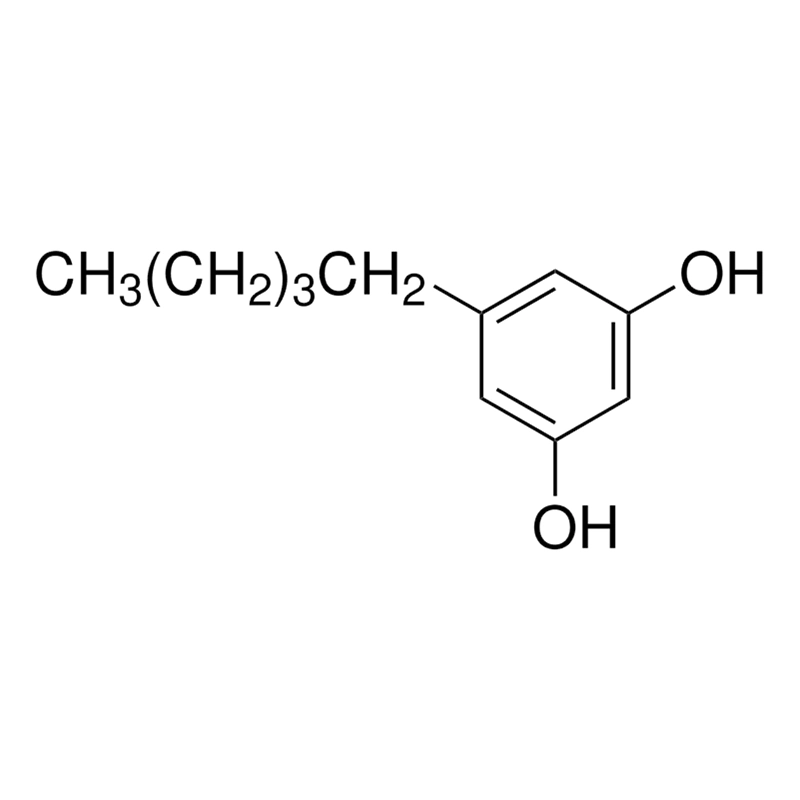
Olivetol exhibits a diverse spectrum of biological activities, demonstrating strong fungicidal and bactericidal efficacy against numerous pathogenic microbial strains. Recent scientific investigations have revealed that, at elevated concentrations, this 3,5-dihydroxyalkylbenzene compound is capable of inducing DNA cleavage in the presence of cupric chloride ($\text{CuCl}_2$) and molecular oxygen ($\text{O}_2$).

These properties have led to its therapeutic application in combating retroviral infections, particularly human immunodeficiency viruses, as well as various malignant tumors including cancers, with clinically observed efficacy.

Parameters
| Melting point | 46-48 °C(lit.) |
| Boiling point | 164 °C |
| density | 1.068±0.06 g/cm3(Predicted) |
| Fp | >230 °F |
| storage temp. | Keep in dark place,Inert atmosphere,Room temperature |
| solubility | Chloroform (Slightly), Methanol (Slightly) |
| form | Solid |
| pka | 9.59±0.10(Predicted) |
| color | Colourless to Beige |
| Stability: | Light Sensitive |
| InChI | InChI=1S/C11H16O2/c1-2-3-4-5-9-6-10(12)8-11(13)7-9/h6-8,12-13H,2-5H2,1H3 |
| InChIKey | IRMPFYJSHJGOPE-UHFFFAOYSA-N |
| SMILES | C1(O)=CC(CCCCC)=CC(O)=C1 |
| CAS DataBase Reference | 500-66-3(CAS DataBase Reference) |
| NIST Chemistry Reference | 1,3-Benzenediol, 5-pentyl-(500-66-3) |
| EPA Substance Registry System | Olivetol (500-66-3) |

These characteristics have driven its clinical application in combating retroviral infections—specifically human immunodeficiency virus (HIV)—as well as various oncological malignancies and tumors, supported by demonstrated therapeutic efficacy.
These characteristics have driven its clinical application in combating retroviral infections—specifically human immunodeficiency virus (HIV)—as well as various oncological malignancies and tumors, supported by demonstrated therapeutic efficacy.


