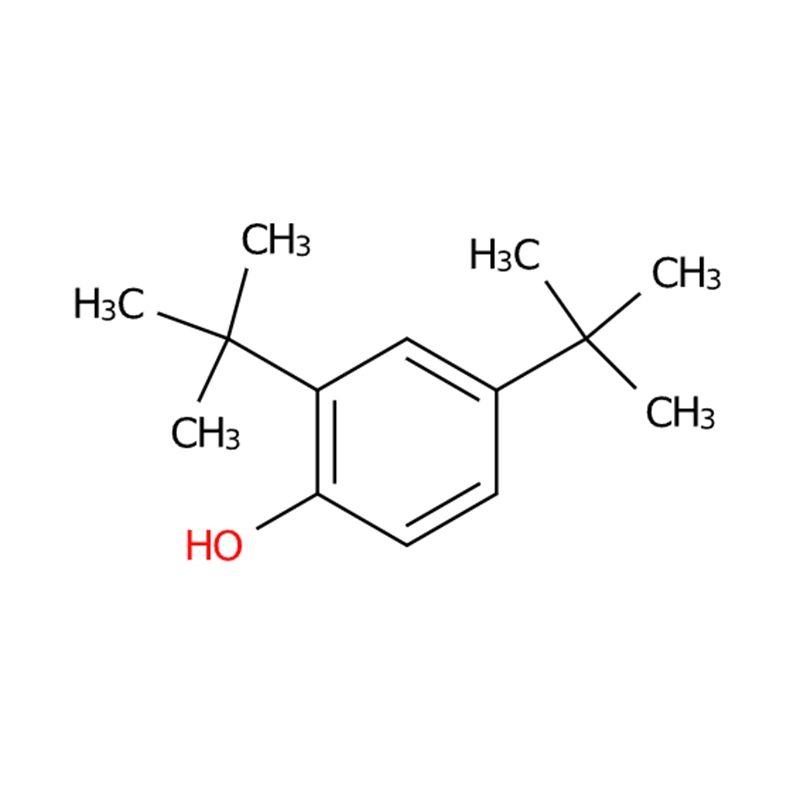
2,4-di-tert-butylphenol CAS#96-76-4 Product Description
2,4-Di-tert-butylphenol (2,4-DTBP) is an important organic compound that occurs naturally in certain plants and serves as a versatile intermediate in fine chemical manufacturing. Owing to its distinctive phenolic structure and antioxidant properties, it is widely used as a key raw material in the production of specialty additives, polymer stabilizers, and other functional chemical products. One of its major applications is in the manufacture of antioxidant 168, where it serves as an important precursor for producing high-performance polymer antioxidants and stabilizing agents.
In the polymer and plastics industries, 2,4-Di-tert-butylphenol is utilized in the synthesis of various polymer-related materials and additives, including products associated with polyisobutylene, polyamide, and polycarbonate manufacturing. It is also employed as a starting material in the preparation of other antioxidants, such as antioxidants 300 and 314, as well as ultraviolet absorbers and light stabilizers, including light stabilizer 120. These downstream products are used to improve the thermal stability, oxidation resistance, and service life of polymer materials.
Furthermore, 2,4-Di-tert-butylphenol has applications in the production of dyes, textile auxiliaries, and 2402 resin. It is also used in the manufacture of synthetic fragrances, activator 460, initiator TBCP, pesticide emulsifiers, and various specialty additive formulations. With its broad synthetic versatility and important role in antioxidant and stabilizer production, 2,4-Di-tert-butylphenol is a valuable intermediate in the fine chemical, polymer, plastics, textile, and agrochemical industries.
2,4-di-tert-butylphenol CAS#96-76-4 Chemical Properties
| Melting point | 53-56 °C(lit.) |
| Boiling point | 265 °C(lit.) |
| Density | 0.887 |
| Vapor pressure | 1 mm Hg ( 84.5 °C) |
| Refractive index | 1.508 |
| Fp | 239 °F |
| Storage temp. | Store below +30°C. |
| Solubility | water: soluble0.033g/L at 25°C |
| Form | Crystalline Solid |
| Pka | 11.56±0.18(Predicted) |
| Color | White to yellow |
| PH | 4.5 (H2O, 20℃)(saturated aqueous solution) |
| Water Solubility | practically insoluble |
| BRN | 1910383 |
| Stability | Stable. Combustible. Incompatible with acid chlorides, oxidizing agents, acid anhydrides, copper, copper alloys, bases, brass. |
| InChIKey | ICKWICRCANNIBI-UHFFFAOYSA-N |
| LogP | 4.8 at 23℃ |
| CAS DataBase Reference | 96-76-4(CAS DataBase Reference) |
| NIST Chemistry Reference | Phenol, 2,4-bis(1,1-dimethylethyl)-(96-76-4) |
| EPA Substance Registry System | 2,4-Di-tert-butylphenol (96-76-4) |
2,4-di-tert-butylphenol CAS#96-76-4 Safety Information
| Hazard Codes | Xi,N,Xn,T,F |
| Risk Statements | 36/37/38-50/53-43-36/38-22-51/53-41-39/23/24/25-23/24/25-11-52/53 |
| Safety Statements | 26-36/37-61-37/39-29-24-45-36/37/39-60 |
| RIDADR | UN 2430 8/PG 3 |
| WGK Germany | 2 |
| RTECS | SK8260000 |
| TSCA | Yes |
| HazardClass | 9 |
| PackingGroup | III |
| HS Code | 29071900 |
| Hazardous Substances Data | 96-76-4(Hazardous Substances Data) |
2,4-di-tert-butylphenol CAS#96-76-4 Product Application
2,4-Di-tert-butylphenol is an important fine chemical intermediate widely used in the manufacture of antioxidants, polymer stabilizers, and ultraviolet absorbers. Owing to its distinctive phenolic structure and antioxidant properties, it serves as a valuable starting material for synthesizing a variety of functional additives designed to improve the stability, durability, and aging resistance of polymer materials. It is particularly important in the production of phosphite-based antioxidants and other high-performance stabilizing agents.
Its major downstream applications include the synthesis of antioxidant 168, antioxidant P-EPQ, and various light stabilizers, such as light stabilizer 120. It is also used as a key raw material in the preparation of ultraviolet absorbers, including UV-327 and UV-320, which help protect polymer products against ultraviolet radiation and light-induced degradation. In addition, it finds applications in the production of reclaimed rubber activators and other specialty rubber additives.
Furthermore, 2,4-Di-tert-butylphenol offers considerable potential as a precursor for the synthesis of various organic intermediates and plasticizer-related compounds. Its role as an important raw material in phosphite antioxidant manufacturing further highlights its significance in the polymer and plastics industries. With its broad synthetic applications, it is widely utilized in the development of antioxidants, UV absorbers, light stabilizers, and other functional chemical additives.