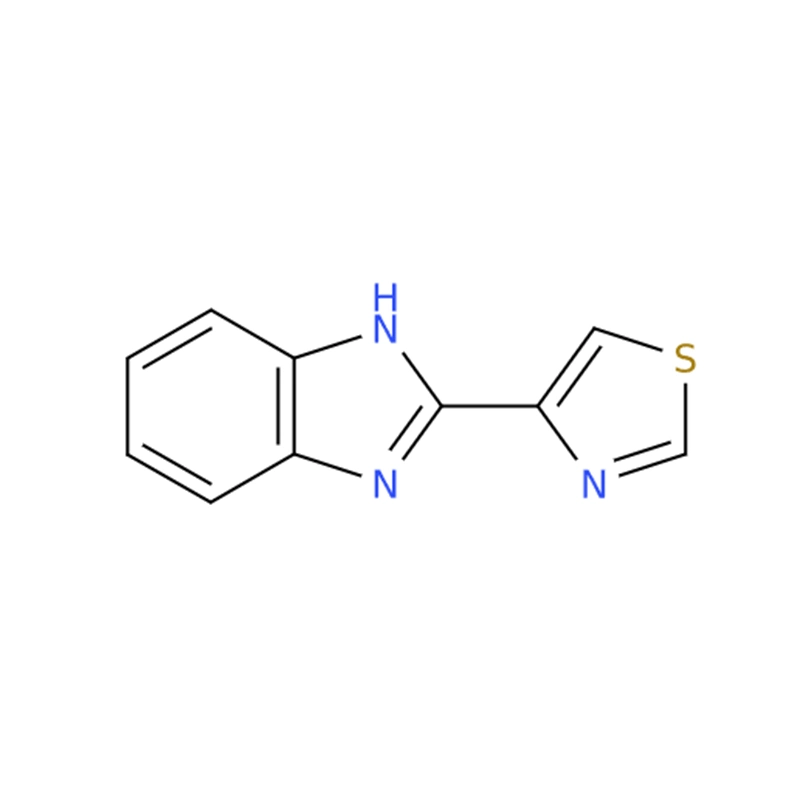
Product Description of Thiabendazole (CAS# 148-79-8)
Thiabendazole, frequently designated under commercial names like Tecto and related trade labels, is a potent broad-spectrum antifungal agent utilized globally. It features acropetal systemic mobility within plant tissues, moving upward toward growing tips while lacking basipetal downward transport. Offering prolonged protective residual activity, it shares cross-resistance patterns with other benzimidazole class fungicides.
The compound effectively suppresses a diverse range of fungal taxa, notably Ascomycota, Basidiomycota, and Deuteromycota. Thiabendazole is extensively employed across agricultural systems both for controlling foliage and crop diseases and for enhancing the post-harvest shelf life of fruits and vegetables.
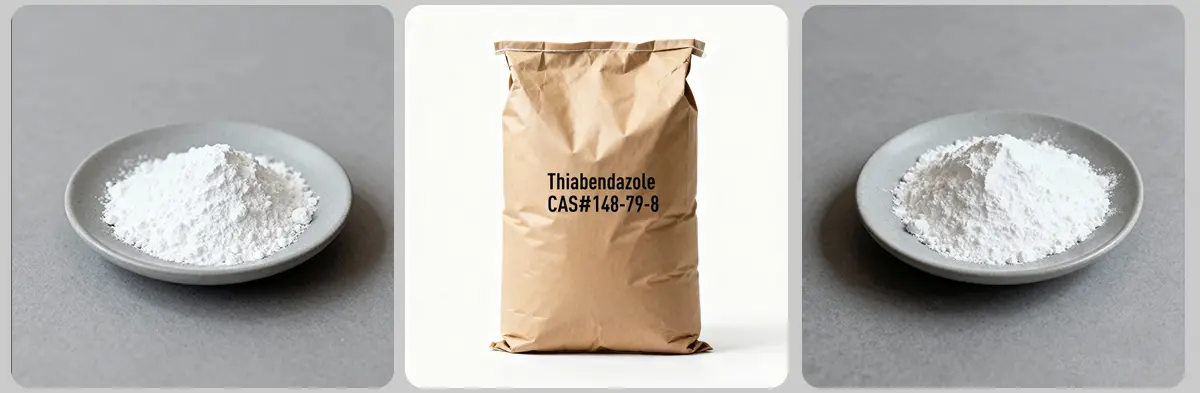
Thiabendazole Chemical Properties
| Melting point | 298-301°C |
| Boiling point | 446.0±37.0 °C(Predicted) |
| density | 1.2271 (rough estimate) |
| vapor pressure | Negligible at room temperature |
| refractive index | 1.5500 (estimate) |
| storage temp. | Sealed in dry,Room Temperature |
| solubility | Soluble in methanol and dimethyl sulfoxide. |
| form | powder |
| pka | pKa 4.7 (Uncertain) |
| color | light yellow |
| Water Solubility | 0.005 g/100 mL |
| Merck | 149289 |
| BRN | 611403 |
| InChIKey | WJCNZQLZVWNLKY-UHFFFAOYSA-N |
| LogP | 2.47 |
| CAS DataBase Reference | 148-79-8(CAS DataBase Reference) |
| NIST Chemistry Reference | Thiabendazole(148-79-8) |
| EPA Substance Registry System | Thiabendazole (148-79-8) |
| Hazard Codes | N,Xi |
| Risk Statements | 50/53-36/37/38 |
| Safety Statements | 60-61-36-26 |
| RIDADR | UN 3077 9/PG 3 |
| WGK Germany | 2 |
| RTECS | DE0700000 |
| TSCA | Yes |
| HazardClass | 9 |
| PackingGroup | III |
| HS Code | 29341000 |
| Hazardous Substances Data | 148-79-8(Hazardous Substances Data) |
| Toxicity | LD50 in mice, rats, rabbits (g/kg): 3.6, 3.1, >3.8 orally (Robinson) |

Product Application of Thiabendazole CAS#148-79-8
Thiabendazole serves as a high-potency, broad-spectrum systemic fungicide featuring extended residual efficacy. Upon root absorption, it moves upward toward the growing foliage but lacks downward basipetal translocational movement. For foliar spraying applications, the suggested dosage is typically 2.25–3.75 g of active ingredient per hectare.
This active compound efficiently manages a wide array of fungal crop infections and root rot pathogens, offering dual preventive and curative protection. Additionally, it is extensively deployed to mitigate post-harvest storage decay in fruits like citrus, apples, pears, and bananas. For post-harvest soaking or dipping, standard treatment solutions range between 500–1000 mg/L or 700–1500 mg/L based on specific produce requirements.
Overall, Thiabendazole stands as an internationally recognized, highly effective antifungal agent with diverse agricultural and post-harvest applications.