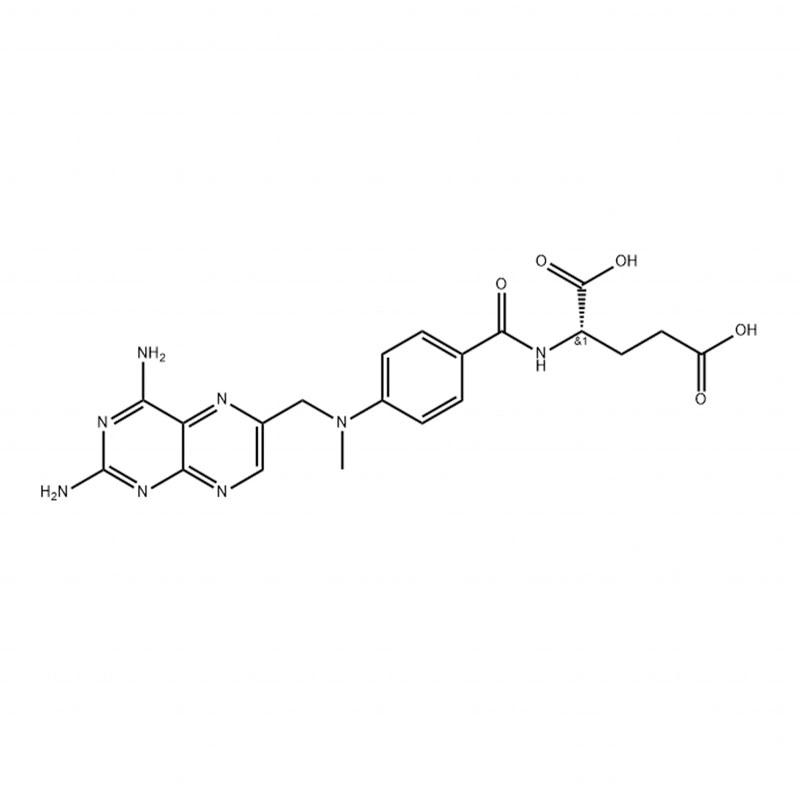
Product Description
Methotrexate (MTX), CAS No. 59-05-2, is an important pharmaceutical active ingredient (API) commonly appearing as a yellow crystalline powder. It is a folate antagonist that inhibits dihydrofolate reductase (DHFR), interfering with folate metabolism and DNA synthesis. Due to its pharmacological properties, Methotrexate is widely used in pharmaceutical formulations for the treatment of certain cancers, autoimmune diseases, and inflammatory conditions. It is slightly soluble in dilute alkaline solutions and poorly soluble in water, requiring appropriate formulation and processing techniques. As a critical medicinal raw material, MTX is subject to strict quality control, GMP manufacturing standards, and pharmaceutical regulatory requirements to ensure its purity, consistency, and safety. It is classified as UN2811, Class 6.1 (Toxic Substance), Packing Group III.
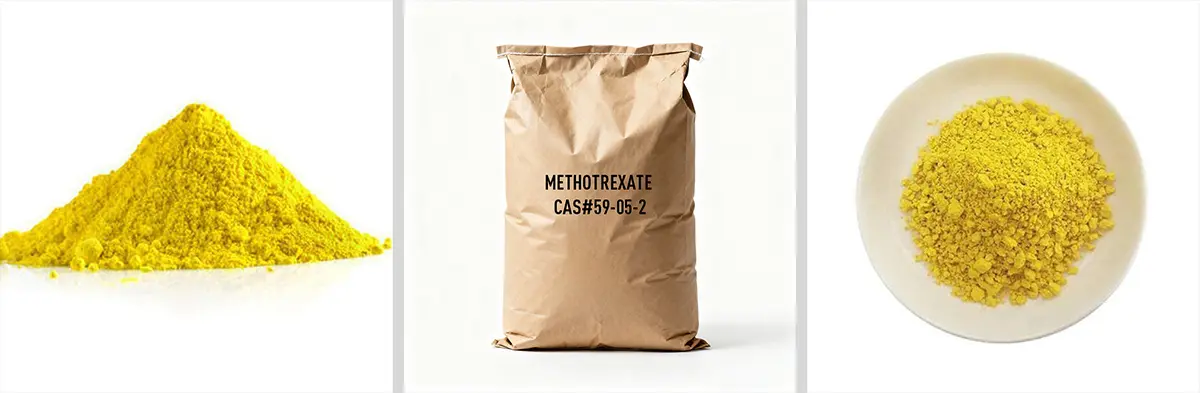
Chemical Properties
| Density | 1.536 |
| Melting point | 195℃ |
| Boiling point | 561.26°C (rough estimate) |
| Refractive index | 1.6910 (estimate) |
| Flash Point | 11℃ |
| Precise Quality | 454.171 |
| PSA | 210.54 |
| logP | 1.8217 |
| Solubility | H2O: insoluble |
| Appearance | yellow crystalline powder |
| Storage | Store at -20°C. Hygroscopic. Light Sensitive. |
| Color/Form | Pale-yellow to Yellow-brown Solid |
| Decomposition | When heated to decomposition it emits toxic fumes including /nitrogen oxides/. |
| pKa | pKa 3.04/4.99(H2O,t =25,I=0.0025) (Uncertain) |
| Water Solubility | Insoluble. |
| Spectral Properties | Specific optical rotation: 20.4 + or - 0.6 deg at 21 deg C/589 D (concentration by 0.1 N sodium hydroxide) maximum absorption: 243nm, A1= 388;307 nm, A1 = 475 (in 0.1 n hydrogen chloride). 258 nm, A1= 544; 303 nm, A1= 546; 372 nm, A1= 177 (in 0.1 N sodium hydroxide)UV max (0.1N HCl) 244, 307 nm; UV max (0.1N NaOH) 257, 302, 370 nm |
| Stability | Stable, but light sensitive and hygroscopic. Incompatible with strong acids, strong oxidizing agents. Store at -15C or below. |
| StorageTemp | −20°C |
Product Application
Methotrexate (MTX) is used in the treatment of various malignancies, including leukemia, choriocarcinoma, and solid tumors. Depending on the disease type and clinical protocol, it may be administered orally, intramuscularly, intrathecally, or through intra-arterial infusion. Treatment regimens vary according to patient age, disease progression, and therapeutic response. In certain chemotherapy protocols, Methotrexate is combined with leucovorin (calcium folinate) rescue therapy to help protect normal cells and reduce drug-related toxicity. It is also an important component of high-dose chemotherapy regimens for osteosarcoma, requiring carefully controlled administration and supportive treatment.
In high-dose Methotrexate therapy, appropriate hydration, urine alkalinization, and leucovorin rescue are essential components of patient management. Close monitoring of liver and kidney function, blood counts, electrolyte balance, and plasma Methotrexate concentrations is necessary to evaluate drug clearance and minimize potential adverse effects. Methotrexate has also been used in the treatment of severe psoriasis, although its application is limited by potential toxicity and significant side effects. Across these therapeutic applications, dosage and administration schedules must be determined by qualified healthcare professionals in accordance with established clinical guidelines and individual patient requirements.