
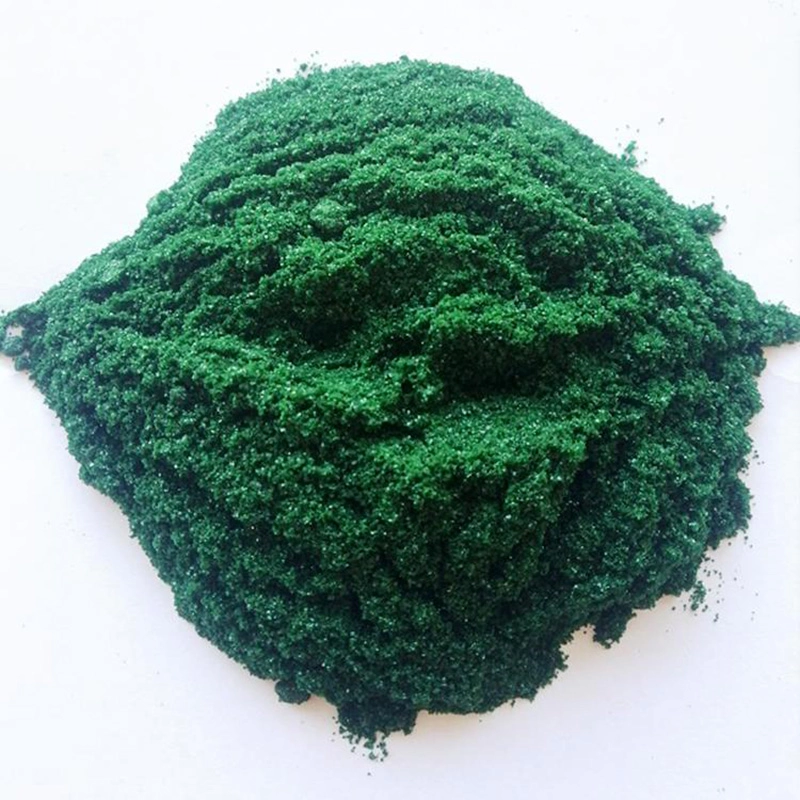
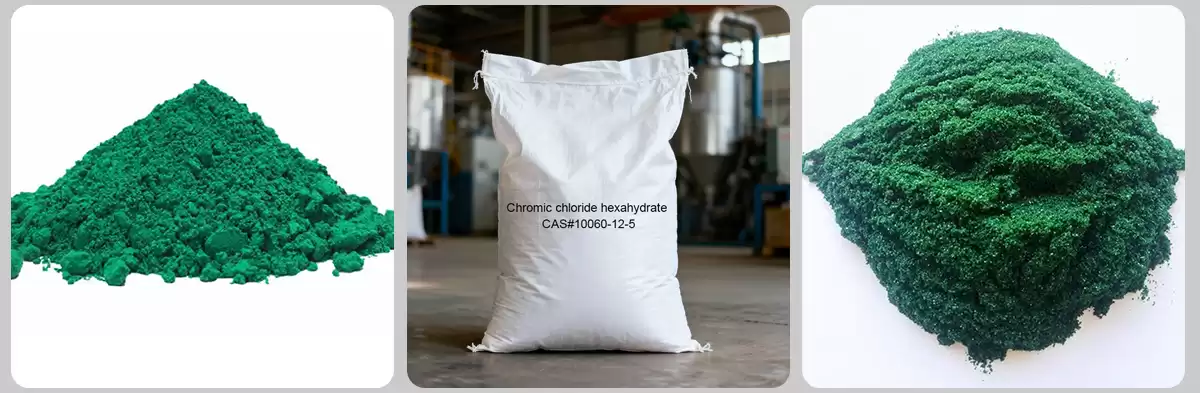
Chromic chloride hexahydrate CAS#10060-12-5
Chromic chloride hexahydrate (CAS No. 10060-12-5), chemical formula CrCl₃·6H₂O, is a widely applied inorganic coordination compound. It exists in two crystal forms: dark green crystalline solid and purple monoclinic crystals. It has a relative density of 1.76 and a melting point of 83°C. This product dissolves in water and ethanol, is slightly soluble in acetone, and insoluble in diethyl ether. It has extensive industrial applications in organic synthesis, electroplating and pigment production.
Chromic Chloride hexahydrate Chemical Properties
| Melting point | 83 °C |
| density | 1.76 g/mL at 25 °C(lit.) |
| storage temp. | Inert atmosphere,Room Temperature |
| solubility | Methanol (Slightly), Water (Slightly) |
| form | Powder/Solid |
| Specific Gravity | 1.76 |
| color | Reddish-violet |
| PH | 2.0-3.0 |
| Water Solubility | Soluble in water and alcohol. Insoluble in diethyl ether. |
| Sensitive | Hygroscopic |
| Merck | 142222 |
| Exposure limits | NIOSH: IDLH 25 mg/m3; TWA 0.5 mg/m3 |
| Stability: | Stable, but may be air-sensitive. Hygroscopic. Incompatible with lithium, nitrogen, strong oxidizing agents. |
| InChIKey | LJAOOBNHPFKCDR-UHFFFAOYSA-K |
| CAS DataBase Reference | 10060-12-5(CAS DataBase Reference) |
| EPA Substance Registry System | Chromium(III) chloride hexahydrate (10060-12-5) |
| Hazard Codes | Xn,N,C |
| Risk Statements | 22-36/37/38-51/53-34 |
| Safety Statements | 24/25-61-45-36/37/39-26 |
| RIDADR | UN3260 |
| WGK Germany | 1 |
| RTECS | GB5450000 |
| TSCA | Yes |
| HazardClass | 8 |
| PackingGroup | III |
Product Application of Chromic Chloride Hexahydrate CAS#10060-12-5
Chromic chloride hexahydrate possesses multiple valuable industrial‑grade functions. Within the printing and dyeing sector, it acts as an effective mordant for textile processing. For the chemical‑manufacturing industry, it serves as critical feedstock for synthesizing a wide range of other chromium salts. In the pigment field, it is applied to produce diverse chromium‑containing pigment products. Moreover, it participates in organic‑synthesis workflows for preparing various chromium‑based catalytic materials.


