
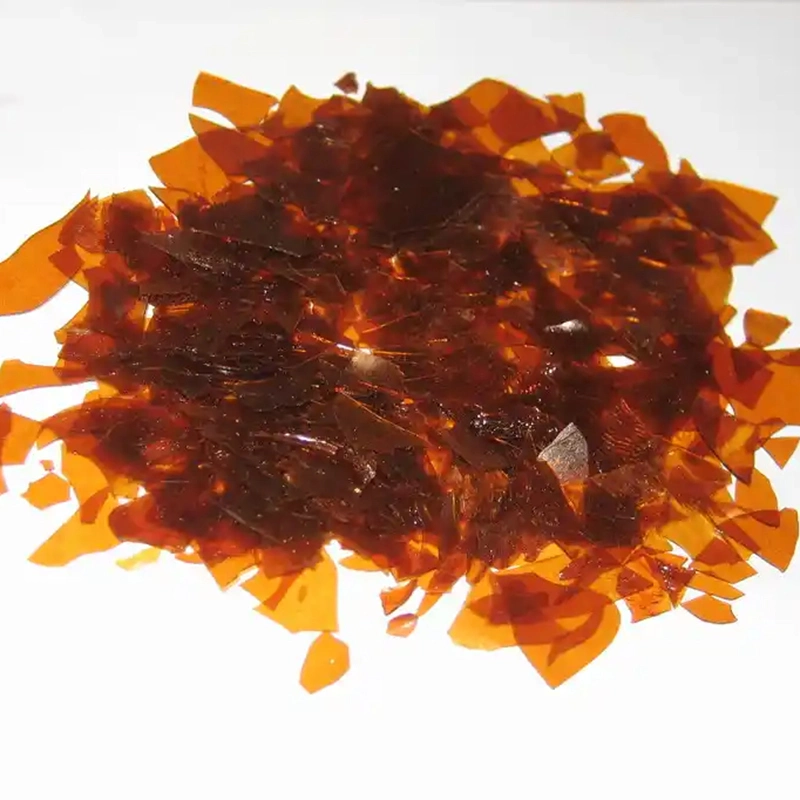
Products Description of Shellac CAS#9000-59-3
Shellac flakes, also called lacquer flakes or purple lac flakes, are produced by melting raw shellac resin or dissolving it in solvents to remove impurities. The color shade of finished shellac flakes can be adjusted to satisfy different application requirements.
As a bio-based coating material, shellac flakes are widely used for furniture and indoor wood finishing. It is free of harmful contaminants, with a mild non-irritating odor, non-toxic and low-sensitizing to human skin. Classified as a premium coating material, shellac can be overcoated on conventional paints and finishes to suppress formaldehyde volatilization and reduce direct skin contact with hazardous substances.
In the domestic market of China, shellac flakes are primarily adopted for glazing and primer varnish of wooden furniture. Nevertheless, the market demand has gradually declined in recent years alongside the emergence of new coating products and continuous upgrading of coating performance. Meanwhile, weakened international market demand and less favorable export conditions have jointly led to a downward trend in shellac flake prices.
Shellac Chemical Properties
| Melting point | 115-120° |
| density | 1.035-1.140 |
| storage temp. | 2-8°C |
| solubility | Practically insoluble in water, gives a more or less opalescent solution (wax containing shellac and bleached shellac) or a clear solution (dewaxed shellac and bleached, dewaxed shellac) in anhydrous ethanol. When warmed it is sparingly soluble or soluble in alkaline solutions. |
| Odor | mild woody |
| Dielectric constant | 2.0(Ambient) |
| Stability: | Stable. Incompatible with strong oxidizing agents. |
| CAS DataBase Reference | 9000-59-3 |
| EPA Substance Registry System | Shellac (9000-59-3) |
| WGK Germany | 3 |


