
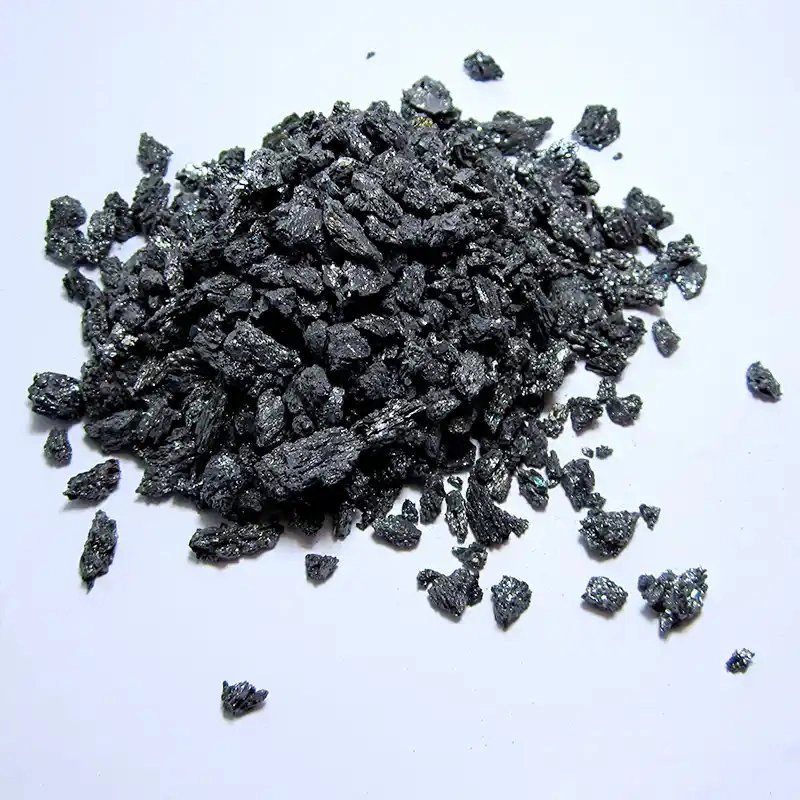
Silicon carbide CAS#409-21-2
Silicon carbide, sometimes nicknamed carborundum, is a ceramic compound composed of silicon and carbon. Naturally, it only occurs as the scarce mineral moissanite. Since 1893, silicon carbide powder has been massively utilized as an abrasive. When sintered, the powder forms rigid ceramic grains. These grains are ideal for high-wear-resistance components including automotive brake pads, clutches and bulletproof panels. Besides, it can be made into electronic parts like LEDs and early radio detectors. In modern industry, silicon carbide is a key raw material for high-temperature and high-voltage semiconductors.
Silicon Carbide Chemical Properties
| Melting point | 2700 °C (lit.) |
| density | 3.22 g/mL at 25 °C (lit.) |
| refractive index | 2.65 |
| solubility | Soluble in molten sodium hydroxide, potassium hydroxide and in molten iron. |
| form | nanopowder |
| color | Green |
| Specific Gravity | 3.22 |
| Resistivity | 107–200 (ρ/μΩ.cm) |
| Water Solubility | Soluble in molten alkalis (NaOH, KOH) and molten iron. Insoluble in water. |
| Crystal Structure | Cubic, Sphalerite Structure - Space Group F(-4)3m |
| Hydrolytic Sensitivity | 1: no significant reaction with aqueous systems |
| Merck | 148492 |
| Exposure limits | ACGIH: TWA 10 mg/m3; TWA 3 mg/m3; TWA 0.1 fiber/cm3 |
| OSHA: TWA 15 mg/m3; TWA 5 mg/m3 | |
| NIOSH: TWA 10 mg/m3; TWA 5 mg/m3 | |
| Stability: | Stability |
| InChIKey | HBMJWWWQQXIZIP-UHFFFAOYSA-N |
| IARC | 2A (Vol. 111) 2017 |
| NIST Chemistry Reference | Silicon monocarbide(409-21-2) |
| EPA Substance Registry System | Silicon carbide (409-21-2) |
| Hazard Codes | Xi |
| Risk Statements | 36/37/38 |
| Safety Statements | 26-36 |
| OEB | B |
| OEL | TWA: 10 mg/m3 (total) |
| WGK Germany | 3 |
| RTECS | VW0450000 |
| TSCA | Yes |
| HS Code | 28492000 |
| Hazardous Substances Data | 409-21-2(Hazardous Substances Data) |
Product Application of Silicon carbide CAS#409-21-2
Boasting excellent thermal stability, superior strength and high thermal conductivity, this material finds broad applications in nuclear energy components, chemical equipment, high-temperature processing units, electric heating elements and resistors. It is also suitable for abrasives, grinding tools, high-grade refractories and fine ceramics.


