Product Description
Chlorhexidine is a broad-spectrum antimicrobial agent widely used in oral healthcare, medical disinfection, and pharmaceutical formulations. In dentistry, it is commonly incorporated into mouthwashes and oral care products to help control dental plaque, reduce bacterial growth, and prevent or manage various oral infections, including gingivitis, acute necrotizing ulcerative gingivitis, and post-operative infections following dental procedures. It is also used in oral care management for patients with weakened immune systems, including those undergoing cancer treatment, and may help manage certain forms of stomatitis and denture-related oral infections.
Beyond oral healthcare, Chlorhexidine is widely utilized as an antiseptic and disinfectant for skin preparation, medical instrument processing, and infection control. It is also incorporated into selected pharmaceutical formulations and has applications as a preservative in certain ophthalmic preparations, subject to formulation compatibility and regulatory requirements. Its broad antimicrobial activity makes it an important ingredient in healthcare, pharmaceutical, and personal care industries.
Chemical Properties
| Name | Chlorhexidine |
| CAS | No.55-56-1 |
| CID | 9552079 |
| EINECS(EC#) | 223-026-6; 200-238-7; 200-302-4 |
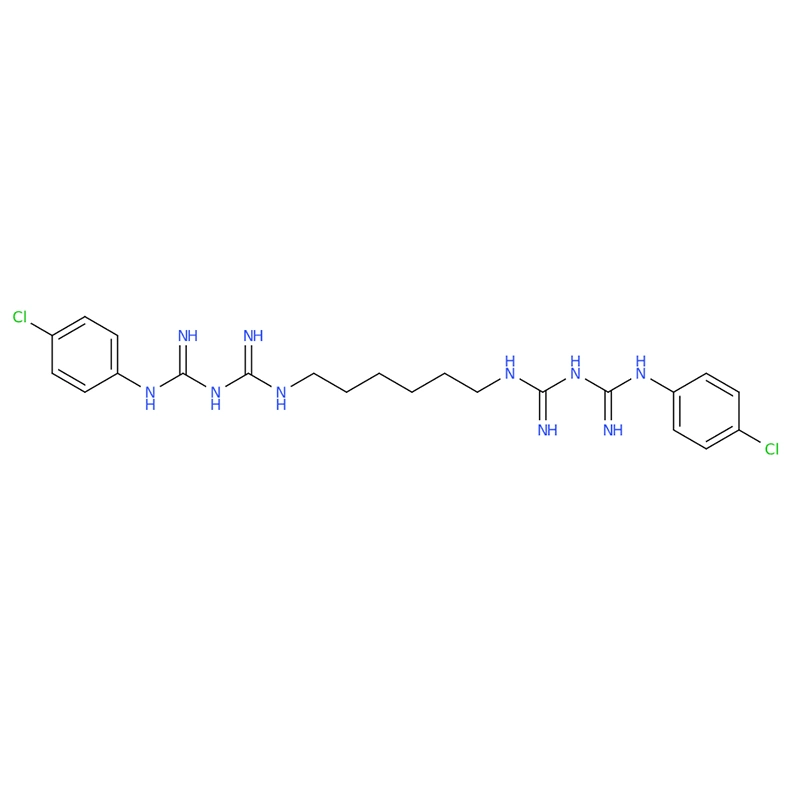
| Molecular Formula | C22H30Cl2N10 (isomer) |
| Inchi | InChI=1S/C22H30Cl2N10/c23-15-5-9-17(10-6-15)31-21(27)33-19(25)29-13-3-1-2-4-14-30-20(26)34-22(28)32-18-11-7-16(24)8-12-18/h5-12H,1-4,13-14H2,(H5,25,27,29,31,33)(H5,26,28,30,32,34) |
| InChIkey | GHXZTYHSJHQHIJ-UHFFFAOYSA-N |
| Canonical Smiles | C1=CC(=CC=C1NC(=NC(=NCCCCCCN=C(N)N=C(N)NC2=CC=C(C=C2)Cl)N)N)Cl |
| Isomers Smiles | C1=CC(=CC=C1N/C(=N/C(=NCCCCCCN=C(/N=C(/NC2=CC=C(C=C2)Cl)\N)N)N)/N)Cl |
| Density | 1.1555 (rough estimate) |
| Melting point | 134-136 °C(lit.) |
| Boiling point | 641.45°C (rough estimate) |
| Refractive index | 1.6300 (estimate) |
| Flash Point | 376.7°C |
| Vapour Pressure | 0.0±1.7 mmHg at 25°C |
| Precise Quality | 564.224 |
| PSA | 204.88 |
| logP | 6.3747 |
| Solubility | 0.08 g/100 mL (20 oC) |
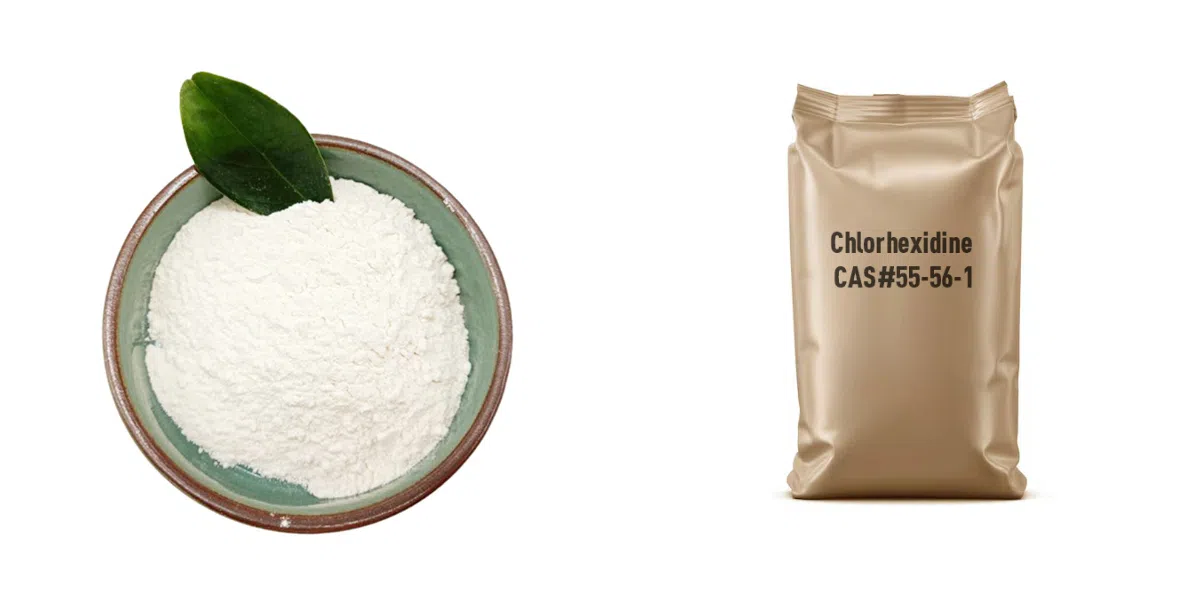
| Appearance | white powder |
| Chemical Properties | Chlorhexidine occurs as an odorless, bitter tasting, white crystallinepowder. |
| Color/Form | Crystals from methanol Solid |
| pKa | pKa 10.78 (Uncertain) |
| Water Solubility | 0.08 g/100 mL (20 oC) |
| Stability | Stable. Incompatible with strong oxidizing agents. |
| StorageTemp | Keep tightly closed. |
Product Application
Chlorhexidine is a broad-spectrum antimicrobial agent widely used in oral healthcare, medical disinfection, and pharmaceutical applications. It is commonly used to prevent and manage various oral conditions, including gingivitis, acute necrotizing ulcerative gingivitis, post-dental surgery infections, and oral infections in immunocompromised patients, such as those undergoing cancer treatment. It is also applied in the management of stomatitis and denture-associated oral infections caused by bacterial or fungal microorganisms. Additionally, Chlorhexidine helps control dental plaque and is used in skin antiseptics, medical instrument disinfection, and selected pharmaceutical formulations.
As a cationic bisbiguanide antimicrobial compound with strong broad-spectrum activity, Chlorhexidine is effective against a wide range of Gram-positive and Gram-negative bacteria. It works by disrupting microbial cell membranes, leading to leakage of intracellular components and ultimately bacterial cell death. Due to its reliable antimicrobial properties, it is widely utilized in dental care products, healthcare disinfectants, pharmaceutical preparations, and personal care formulations.