
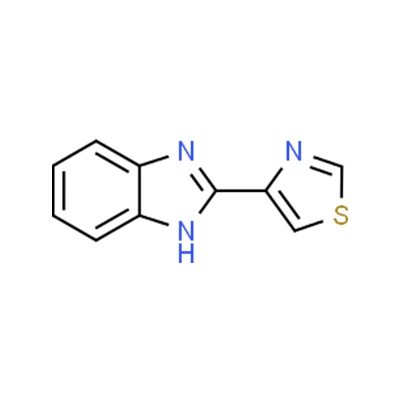
Product Description
Thiabendazole, also known as Tekodo, Tibilin and Thiobendazole, exhibits systemic acropetal translocation but no basipetal movement within plants. It delivers long‑lasting efficacy and shows cross‑resistance with other benzimidazole fungicides. It inhibits ascomycetes, basidiomycetes and deuteromycetes. Widely applied for controlling fungal diseases on various crops and post‑harvest preservation of fruits and vegetables, it is a high‑efficiency, broad‑spectrum fungicide used globally.
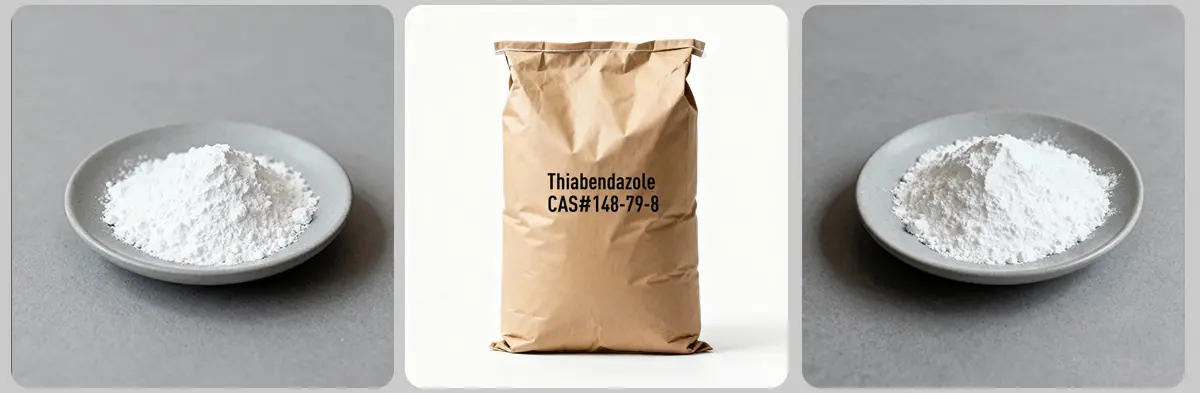
Chemical Properties
| Melting point | 298-301°C |
| Boiling point | 446.0±37.0 °C(Predicted) |
| density | 1.2271 (rough estimate) |
| vapor pressure | Negligible at room temperature |
| refractive index | 1.5500 (estimate) |
| storage temp. | Sealed in dry,Room Temperature |
| solubility | Soluble in methanol and dimethyl sulfoxide. |
| form | powder |
| pka | pKa 4.7 (Uncertain) |
| color | light yellow |
| Water Solubility | 0.005 g/100 mL |
| Merck | 149289 |
| BRN | 611403 |
| InChIKey | WJCNZQLZVWNLKY-UHFFFAOYSA-N |
| LogP | 2.47 |
| CAS DataBase Reference | 148-79-8(CAS DataBase Reference) |
| NIST Chemistry Reference | Thiabendazole(148-79-8) |
| EPA Substance Registry System | Thiabendazole (148-79-8) |
| Hazard Codes | N,Xi |
| Risk Statements | 50/53-36/37/38 |
| Safety Statements | 60-61-36-26 |
| RIDADR | UN 3077 9/PG 3 |
| WGK Germany | 2 |
| RTECS | DE0700000 |
| TSCA | Yes |
| HazardClass | 9 |
| PackingGroup | III |
| HS Code | 29341000 |
| Hazardous Substances Data | 148-79-8(Hazardous Substances Data) |
| Toxicity | LD50 in mice, rats, rabbits (g/kg): 3.6, 3.1, >3.8 orally (Robinson) |
Product Usage
It is a broad-spectrum, highly effective systemic fungicide with long-lasting activity. When absorbed through the roots, it can move upward through the plant but shows limited downward translocation. It is applied as a foliar spray to prevent and control various fungal diseases and root rot in crops, providing both preventive and curative effects.
It is also used to control postharvest fungal diseases in fruits, including citrus, apples, pears, and bananas. In addition, it helps reduce fungal infection during storage, thereby maintaining fruit quality and extending shelf life.


