
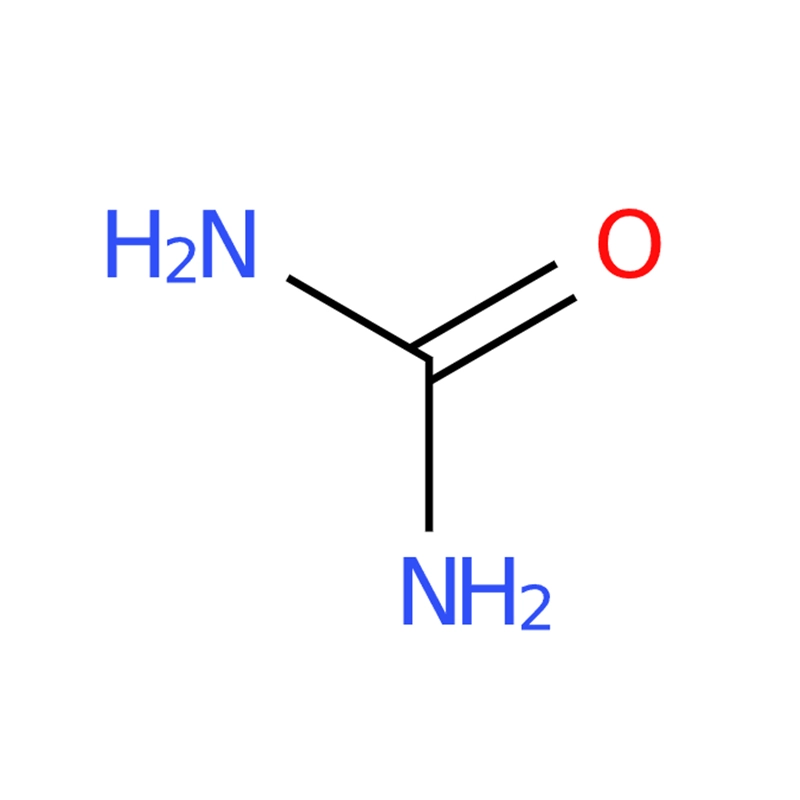
Products Description
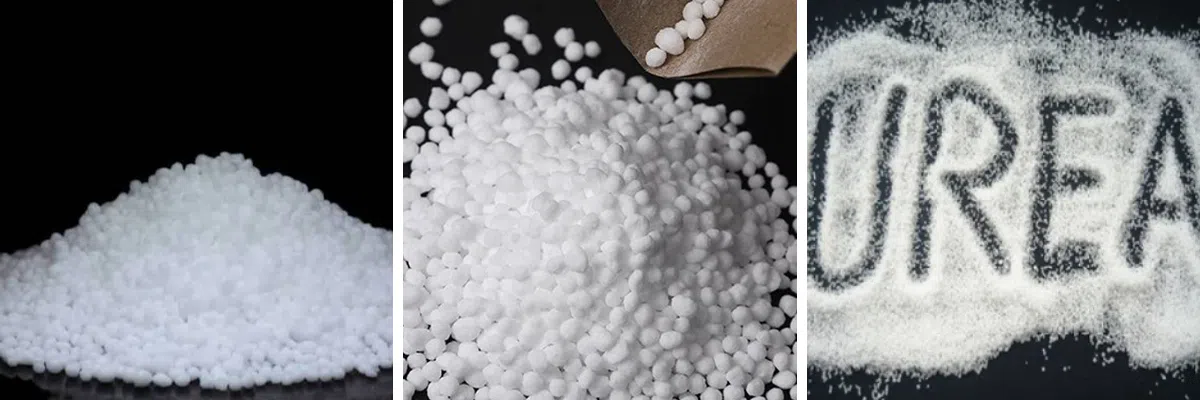
Urea Chemical Properties
Field | Value |
|---|---|
Melting point | 132–135 °C (lit.); decomposes at ~135 °C |
Boiling point | Decomposes before boiling (332.48 °C is a calculated estimate, not actual) |
Density | 1.335 g/mL at 25 °C; 1.32 g/cm³ at 20 °C |
Vapor pressure | <0.1 hPa (20 °C) / 0.007 mmHg at 20 °C — negligible |
Refractive index | n²⁰/D 1.40 |
Storage temp. | 10–30 °C, keep tightly closed (some grades 2–8 °C) |
Solubility | H₂O: 8 M at 20 °C, clear, colorless (~480 g/L); up to 1080 g/L at 20 °C; soluble in methanol, ethanol, conc. HCl; practically insoluble in chloroform and ether |
Form | White crystalline solid (powder / granules / prills) |
pKa | 0.10 at 25 °C (conjugate acid of urea) |
Color | White |
Specific Gravity | 1.335 |
Odor | Odorless or faint ammonia-like |
pH | 7.5–9.5 (480 g/L, H₂O, 25 °C); 9 (20 °C, 100 g/L); 8.0–10.0 (8 M in H₂O) |
Water Solubility | 1080 g/L at 20 °C (≈1.08 kg/L) |
Amax (λmax) | No significant UV/Vis chromophore (Amax 0.02 at 280 nm, 1 M in H₂O; ≤0.06 at 260/280 nm at 5 M) |
Merck | 14, 9867 (14th ed.); 15, 10052 (15th ed.) |
BRN | 635724 |
Dielectric constant | 3.5 (ambient) |
Stability | Stable under normal storage; hygroscopic — protect from moisture; incompatible with strong oxidizers, strong acids/bases, hypochlorites; decomposes above ~135 °C releasing ammonia |
InChIKey | XSQUKJJJFZCRTK-UHFFFAOYSA-N |
LogP | −1.43 (computed); −1.66 (est.); XLogP3 ≈ −1.4 |
CAS DataBase Reference | 57-13-6 (CAS DataBase Reference) |
NIST Chemistry Reference | Urea (57-13-6) — NIST Chemistry WebBook (SRD 69): webbook.nist.gov/cgi/cbook.cgi?ID=C57136 |
EPA Substance Registry System | 57-13-6 (EPA Substance); DTXSID4021426 (EPA CompTox/DSSTox) |
Safety Information
Field | Value |
|---|---|
Hazard Codes | Xn (Harmful), Xi (Irritant); GHS07 (exclamation mark) |
Risk Statements | R36/37/38 – Irritating to eyes, respiratory system and skin; R40 – Limited evidence of a carcinogenic effect |
Safety Statements | S26 – In case of contact with eyes, rinse immediately with plenty of water and seek medical advice; S36 – Wear suitable protective clothing; S24/25 – Avoid contact with skin and eyes |
RIDADR | Not regulated – non-hazardous for all modes of transport |
WGK Germany | WGK 1 – slightly hazardous to water |
RTECS | YR6250000 |
TSCA | Listed (TSCA 8(b) inventory) |
HS Code | 3102.10.10 (fertilizer grade); 2924.10.00 series for technical/resin grades |
Hazardous Substances Data | 57-13-6 (Hazardous Substances Data reference) |
Toxicity | Acute oral LD₅₀ (rat): 8,471 mg/kg; dermal LD₅₀ (rat): 8,200 mg/kg. Other literature values: oral rat ~14,300 mg/kg; mouse 11,500–13,000 mg/kg. Not classified as a carcinogen (NTP: no; IARC: not listed). Irritating to eyes/skin on concentrated contact |
Urea is a naturally occurring compound that regulates nitrogen excretion in mammals: produced in the liver during protein breakdown and eliminated via urine. Present in the skin, it functions as both an emollient and a diuretic.
In protein research, urea acts as a denaturant and a mild solubilizing agent for insoluble or denatured proteins. It is particularly effective for renaturing proteins from samples pre-denatured with 6 M guanidine chloride, such as inclusion bodies, and can be used together with guanidine hydrochloride and dithiothreitol (DTT) to refold denatured proteins into their native, active forms.
.


