
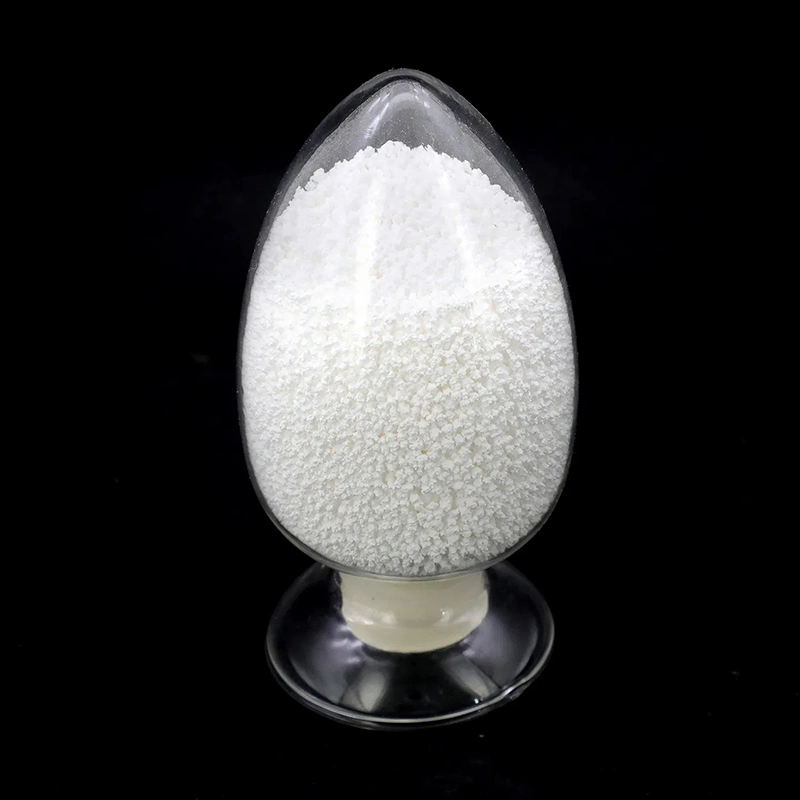
Calcium chloride CAS# 10043-52-4
Calcium chloride (CaCl₂) is a colourless, deliquescent solid readily soluble in water and ethanol. It is commonly manufactured by reacting calcium carbonate with hydrochloric acid, or via the reaction between calcium hydroxide and ammonium chloride. This chemical compound finds practical uses in medical applications, and also serves as an antifreeze and coagulant.
From a chemical‑compatibility perspective, aqueous calcium chloride solution behaves as a weak base. In humid conditions, it reacts with zinc metal to generate highly flammable hydrogen gas. Its dissolution in water releases substantial heat, which means the process is strongly exothermic. Calcium chloride is chemically incompatible with bromine trifluoride, 2‑furan, percarboxylic acids and other substances. Under moist environments, it may also corrode certain metals and construction materials.
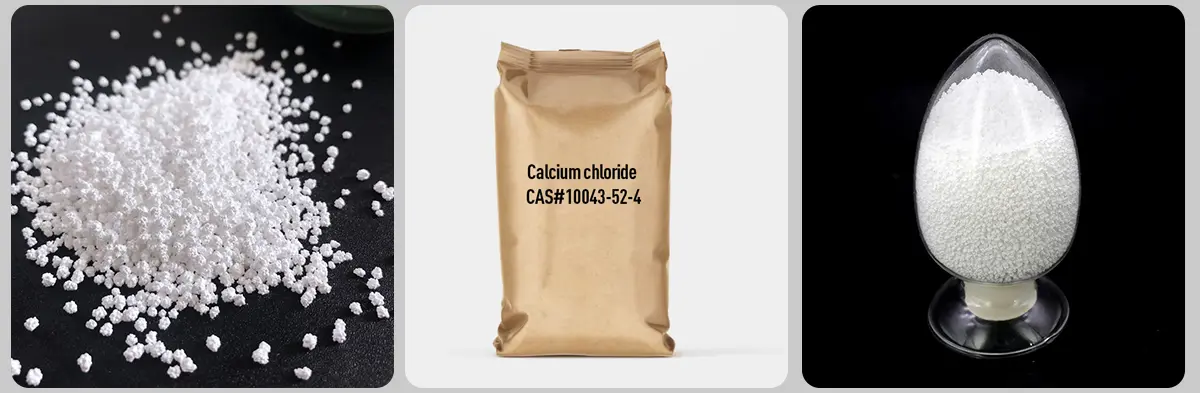
Calcium Chloride Chemical Properties
| Melting point | 772 °C (lit.) |
| Boiling point | 1935 °C/1 atm (lit.) |
| Density | 1.086 g/mL at 20 °C |
| Vapor pressure | 0.01 mm Hg ( 20 °C) |
| Refractive index | n20/D 1.358 |
| Fp | >1600°C |
| Storage temp | Store at +5°C to +30°C. |
| Solubility | H2O: soluble |
| Form | powder |
| Color | White to gray |
| Specific Gravity | 2.15 |
| PH | 8-10 (100g/l, H2O, 20℃) |
| Water Solubility | 740 g/L (20 ºC) |
| Sensitive | Hygroscopic |
| λmax | λ: 260 nm Amax: 0.04 λ: 280 nm Amax: 0.02 |
| Crystal Structure | CaCl2 type |
| Crystal system | Nogata |
| Merck | 14,1659 |
| Space group | Pnnm |
| Lattice constant | a/nmb/nmc/nmα/oβ/oγ/oV/nm30.6240.6430.429090900.1685 |
| Stability | Stable. Incompatible with zinc, water, strong acids, methyl vinyl ether, bromine trifluoride, boron oxide, calcium oxide. Hygroscopic. |
| InChIKey | UXVMQQNJUSDDNG-UHFFFAOYSA-L |
| CAS DataBase Reference | 10043-52-4(CAS DataBase Reference) |
| NIST Chemistry Reference | Calcium dichloride(10043-52-4) |
| EPA Substance Registry System | Calcium chloride (10043-52-4) |
Product Application of Calcium Chloride
Calcium chloride covers a broad spectrum of end‑use scenarios. It works as a desiccant, is widely adopted for highway de‑icing, delivers dust‑suppression performance, and can thaw construction materials such as sand, gravel and concrete. Furthermore, it finds application within food and pharmaceutical industries and may serve as a fungicide.
Based on available human‑relevant test data, it shows noted tumorigenic, mutagenic and hormone‑related activity. Calcium chloride is also deployed as road salt, laboratory desiccating agent, and dehydrating medium for organic liquids and gases. Its common uses also include refrigeration brines, antifreeze formulations, food additives, concrete hardening agents and many other fields.


