
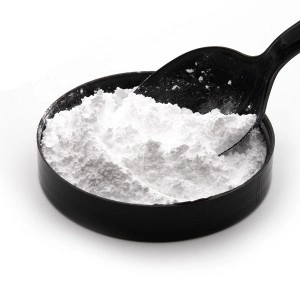
Magnesium oxide CAS#1309-48-4
Magnesium oxide, also commonly known as magnesia, is a typical alkaline earth metal oxide with the formula MgO. It is a white powdery solid, featuring a melting point of 2852°C, a boiling point of 3600°C, and a relative density of 3.58 at 25°C. It dissolves in acids and ammonium salt solutions, and reacts slowly with water to generate magnesium hydroxide. In aqueous carbon dioxide solutions, it forms magnesium bicarbonate. This material readily absorbs moisture and carbon dioxide from air, and will emit irritating fumes when heated.
Major raw materials for manufacturing magnesium oxide are magnesite (MgCO₃), dolomite (MgCO₃·CaCO₃) and seawater. One production route relies on thermal decomposition of magnesite or dolomite. As an alternative process, calcium hydroxide is added to seawater to precipitate magnesium hydroxide, which is further calcined into magnesium oxide.
Another approach uses magnesium‑chloride‑rich brine sourced from seawater or post‑bromine‑extraction brine. By introducing sodium hydroxide or sodium carbonate, magnesium hydroxide or basic magnesium carbonate precipitates are generated. The precipitates are then calcined to produce magnesium oxide. At present, Chinese manufacturers mainly adopt magnesite, dolomite, brine or solid brine blocks as feedstock.
Magnesium Oxide Chemical Properties
| Melting point | 2852 °C (lit.) |
| Boiling point | 3600 °C |
| density | 3.58 |
| refractive index | 1.736 |
| Fp | 3600°C |
| storage temp. | no restrictions. |
| solubility | 5 M HCl: 0.1 M at 20 °C, clear, colorless |
| form | nanopowder |
| color | White |
| Specific Gravity | 3.58 |
| PH | 10.3 (H2O, 20℃)(saturated solution) |
| Odor | wh. powd. or cryst., odorless |
| Resistivity | 1.3 ∞ 10*15 (ρ/μΩ.cm) |
| Water Solubility | 6.2 mg/L (20 ºC), reacts |
| Sensitive | Air Sensitive |
| λmax | λ: 260 nm Amax: ≤0.040 λ: 280 nm Amax: ≤0.025 |
| Crystal Structure | Cubic |
| Merck | 14,5677 |
| Exposure limits | ACGIH: TWA 10 mg/m3 OSHA: TWA 15 mg/m3 NIOSH: IDLH 750 mg/m3 |
| Dielectric constant | 9.7(0.0℃) |
| Stability: | Stable. Incompatible with bromine trifluoride, bromine trichloride, phosphorus pentachloride. |
| InChIKey | CPLXHLVBOLITMK-UHFFFAOYSA-N |
| CAS DataBase Reference | 1309-48-4(CAS DataBase Reference) |
| NIST Chemistry Reference | Magnesium monoxide(1309-48-4) |
| EPA Substance Registry System | Magnesium oxide (1309-48-4) |


