
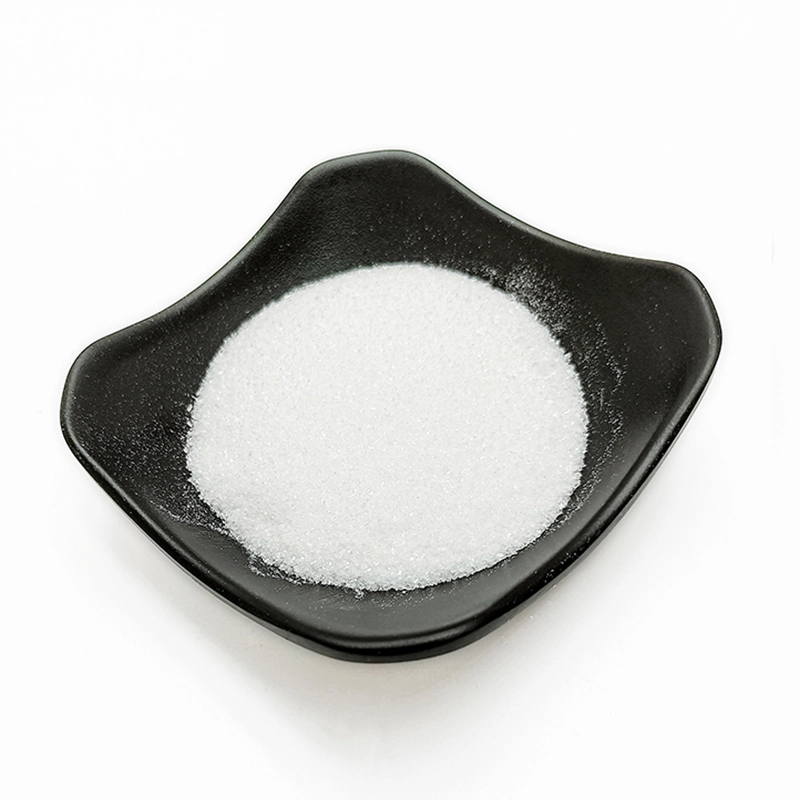
Products Description of Stannous Chloride Dihydrate CAS#10025-69-1
Stannous chloride, also named tin dichloride with the formula SnCl₂, is available in anhydrous and hydrated grades. The anhydrous form is transparent crystalline solid. It has a melting point of 246 ℃, boiling point of 652 ℃ and relative density of 3.95. It is soluble in water but easily oxidized in air to generate insoluble tin oxychloride. Its aqueous solution is prone to hydrolysis, forming basic stannous chloride precipitate [Sn(OH)Cl]. To inhibit hydrolysis, dissolve it in concentrated hydrochloric acid first before dilution. Since it is susceptible to aerial oxidation, adding metallic tin granules can effectively slow down oxidation.
Stannous chloride dihydrate (SnCl₂·2H₂O) is a colorless monoclinic or flaky crystal. Its melting point is 37.7 ℃ and relative density is 2.71. It loses crystal water when heated up to 100 ℃. As a versatile chemical raw material, stannous chloride serves as reducing agent, mordant, decolorant and analytical reagent in chemical industry, and it is commonly used for tin plating in electroplating processes.
Anhydrous stannous chloride is synthesized through the direct reaction between molten tin and chlorine gas. The dihydrate product is obtained by reacting tin flakes with hydrochloric acid, followed by evaporation and crystallization.
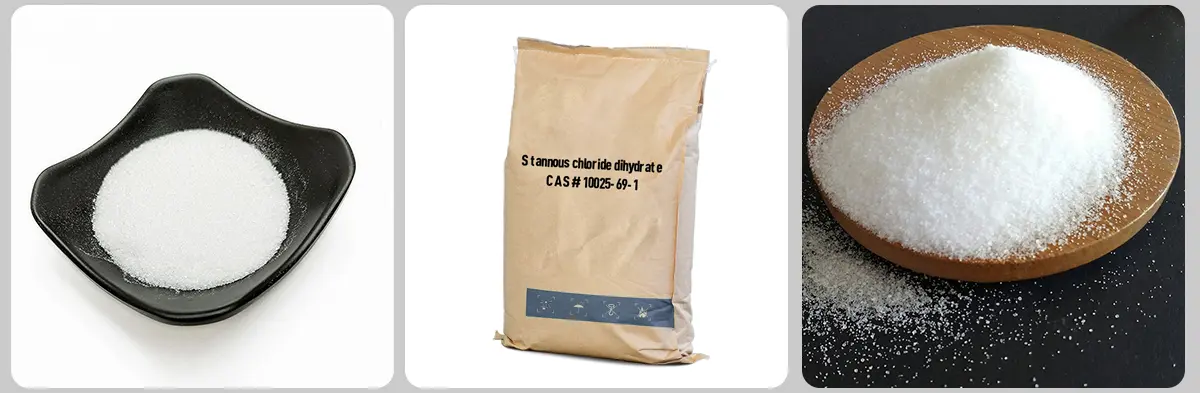
Stannous chloride dihydrate Chemical Properties
| Melting point | 37-38 °C (dec.)(lit.) |
| Boiling point | 652 °C(lit.) |
| density | 2.71 |
| storage temp. | Store at +15°C to +25°C. |
| solubility | hydrochloric acid |
| form | Solid |
| color | White or colorless |
| Specific Gravity | 2.71 |
| PH | 1-2 (100g/l, H2O, 20℃) |
| Water Solubility | 1187 g/L (20 ºC) |
| Sensitive | Air Sensitive |
| Merck | 148,783 |
| Exposure limits | ACGIH: TWA 2 mg/m3 |
| NIOSH: IDLH 100 mg/m3; TWA 2 mg/m3 | |
| Stability: | Stable. Incompatible with strong oxidizing agents, alkali metals, ammonia, alcohols, alkalies, nitrates, boron trifluoride, boron trichloride, carbides. |
| InChIKey | AXZWODMDQAVCJE-UHFFFAOYSA-L |
| CAS DataBase Reference | 10025-69-1(CAS DataBase Reference) |
| EPA Substance Registry System | Tin chloride (SnCl2), dihydrate (10025-69-1) |
Product Application of Stannous Chloride Dihydrate CAS#10025-69-1
Stannous chloride dihydrate acts as an important reducing agent for manufacturing dye intermediates and is also an ingredient for ultra‑high‑pressure lubricating oils. It can be used as a bleaching agent. In mirror‑making processes, it performs sensitization treatment for mercury plating, facilitating the formation of bright silver films with favorable mercury adhesion performance.
Within the electroplating sector, it is adopted for tin plating and copper‑tin alloy plating on mechanical parts. It also carries out pre‑plating sensitization for ABS plastics, which enhances coating bonding strength and avoids peeling‑off defects.
Furthermore, it finds deployment in pharmaceutical synthesis and works as a catalyst for organic chemical reactions. It serves as an activator during the vulcanization of butyl‑rubber goods. In textile dyeing, it functions as a mordant and a dye‑resisting agent for discharge printing. In the flavor‑and‑fragrance field, it is applied as a stabilizer. For food‑grade scenarios, it can be utilized as a reducing agent and antioxidant, for instance in canned asparagus and pineapple juice processing.


