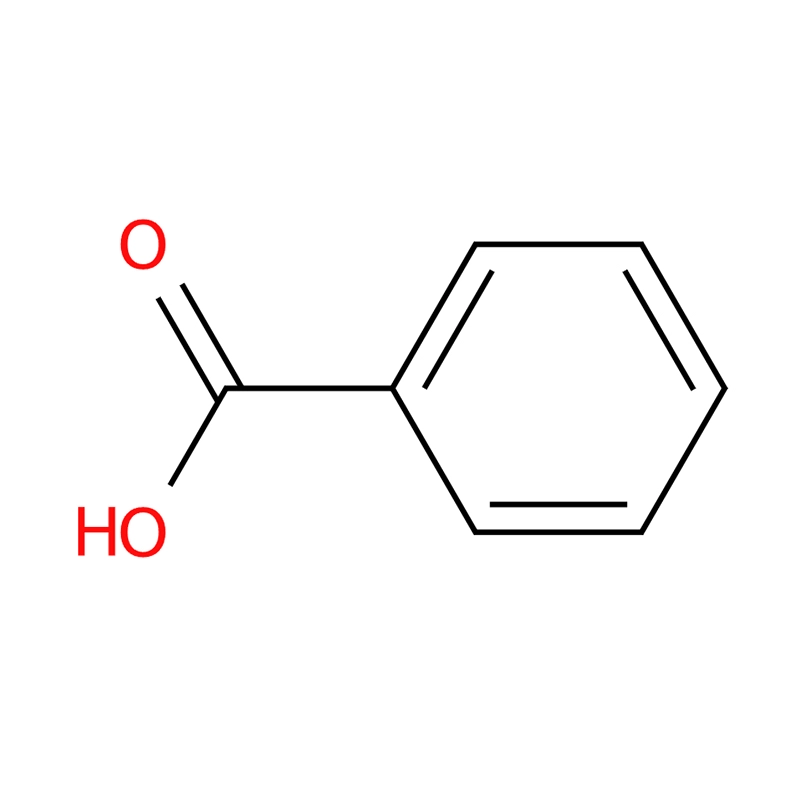
Benzoic Acid CAS#65-85-0 Product Description
Benzoic acid is the simplest aromatic carboxylic acid and a weak organic acid widely used as a raw material in the production of various important organic compounds. More than 90% of commercially produced benzoic acid is further processed into valuable chemicals, including phenol and caprolactam. Its application in manufacturing glycol benzoates, which serve as plasticizers in adhesive formulations, is also expanding.
In addition, benzoic acid is utilized in the production of alkyd resins and drilling fluid additives for crude oil extraction. Other industrial applications include rubber polymerization activators and retarders, resin manufacturing, alkyd paints, plasticizers, dyes, and synthetic fibers. Naturally occurring benzoic acid and its esters can also be found in apricots, cranberries, mushrooms, and jasmine plants.
The history of benzoic acid can be traced back to the 16th century. In 1875, the scientist Salkowski identified its antifungal properties, contributing to its subsequent use in medicinal applications. Benzoic acid is a principal component of benzoin resin and is also an ingredient in Whitfield’s ointment, a topical preparation used to treat fungal skin infections such as tinea, ringworm, and athlete’s foot.
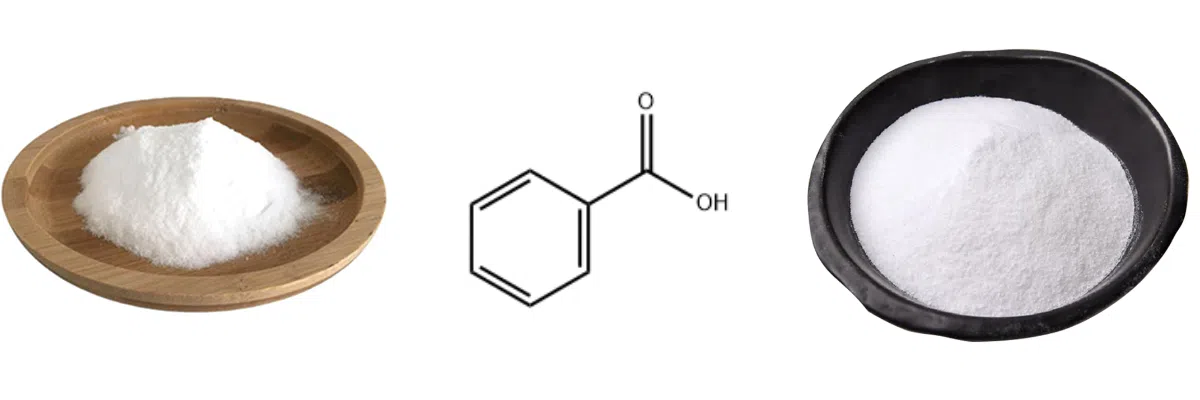
Benzoic Acid CAS#65-85-0 Chemical Properties
| Melting point | 121-125 °C(lit.) |
| Boiling point | 249 °C(lit.) |
| density | 1.08 |
| bulk density | 500kg/m3 |
| vapor density | 4.21 (vs air) |
| vapor pressure | 10 mm Hg ( 132 °C) |
| refractive index | 1.504 |
| FEMA | 2131 | BENZOIC ACID |
| Fp | 250 °F |
| storage temp. | 2-8°C |
| solubility | soluble, clear, colorless (95% ethanol, 1gm/3mL) |
| form | Solid |
| pka | 4.19(at 25℃) |
| color | White to yellow-beige to orange |
| PH | 3.66(1 mM solution);3.12(10 mM solution);2.6(100 mM solution); |
| Odor | at 100.00 %. faint balsam urine |
| Odor Type | balsamic |
| biological source | synthetic |
| Water Solubility | Slightly soluble. 0.34 g/100 mL |
| JECFA Number | 850 |
| Merck | 14,1091 |
| BRN | 636131 |
| Henry's Law Constant | (x 10-8 atmm3/mol): 7.02 (calculated, U.S. EPA, 1980a) |
| Stability: | Stable. Combustible. Incompatible with strong bases, strong oxidizing agents, alkalies. |
| Cosmetics Ingredients Functions | pH ADJUSTERS PRESERVATIVE FRAGRANCE |
| Cosmetic Ingredient Review (CIR) | Benzoic acid (65-85-0) |
| InChI | 1S/C7H6O2/c8-7(9)6-4-2-1-3-5-6/h1-5H,(H,8,9) |
| InChIKey | WPYMKLBDIGXBTP-UHFFFAOYSA-N |
| SMILES | OC(=O)c1ccccc1 |
| LogP | 1.870 |
| CAS DataBase Reference | 65-85-0(CAS DataBase Reference) |
| NIST Chemistry Reference | Benzoic acid(65-85-0) |
| EPA Substance Registry System | Benzoic acid (65-85-0) |
Benzoic Acid CAS#65-85-0 Safety Information
| Hazard Codes | Xn,T,Xi |
| Risk Statements | 22-36-42/43-36/37/38-40-63-43-23/24/25-45-41-37/38-20/21/22-48/23-38-67-37 |
| Safety Statements | 26-45-37/39-24-22-36/37-24/25-23-53-36-63-39 |
| RIDADR | UN 3077 9/PG 3 |
| WGK Germany | 1 |
| RTECS | DG0875000 |
| F | 21 |
| Autoignition Temperature | 570 °C |
| Hazard Note | Harmful |
| TSCA | TSCA listed |
| HS Code | 2916 31 00 |
| HazardClass | 9 |
| Storage Class | 6.1C - Combustible acute toxic Cat.3 toxic compounds or compounds which causing chronic effects |
| Hazard Classifications | Eye Dam. 1 Skin Irrit. 2 STOT RE 1 Inhalation |
| Hazardous Substances Data | 65-85-0(Hazardous Substances Data) |
| Toxicity | LD50 orally in Rabbit: 1700 mg/kg LD50 dermal Rabbit > 5000 mg/kg |
Benzoic Acid CAS#65-85-0 Product Application
1. Application in Food Preservation
Benzoic acid is an important food preservative. Under acidic conditions, it inhibits the growth of molds, yeasts, and certain bacteria, although its effectiveness against acid-producing bacteria is relatively limited. Its antimicrobial activity is generally most effective at pH values between 2.5 and 4.0, while its use may also be suitable for certain food products with pH values ranging from 4.5 to 5.0, depending on the formulation.
Benzoic acid is used in various food products, including concentrated fruit and vegetable juices packaged in plastic containers, jams (excluding canned products), fruit juice drinks, soy sauce, vinegar, soft candies, alcoholic beverages, low-salt pickled vegetables, sauces, preserved fruits, and carbonated drinks.
The maximum permitted usage levels vary according to the food category and applicable regulations. The dosage figures cited in the original reference include 2.0 g/kg for concentrated fruit and vegetable juices, 1.0 g/kg for jams, fruit juice drinks, soy sauce, and vinegar, 0.8 g/kg for soft candies and certain alcoholic beverages, 0.5 g/kg for low-salt pickled vegetables, sauces, and preserved fruits, and 0.2 g/kg for carbonated drinks. These figures should be verified against the relevant food safety standards before commercial or technical use.
Due to its relatively low solubility in water, benzoic acid may be dissolved in a small amount of ethanol or warm water to facilitate incorporation into food formulations.
2. Preservative and Antimicrobial Agent
Benzoic acid is widely used as a preservative and antimicrobial agent in suitable applications. Because of its limited water solubility, adequate stirring is necessary during preparation. Alternatively, it can be dissolved in a small quantity of warm water or ethanol to improve dispersion.
When used in beverages containing concentrated fruit juice, sodium benzoate may be preferred in certain formulations because of its greater water solubility. Benzoic acid can also be volatile under certain processing conditions, so formulation and processing methods should be selected according to the intended application.
Sodium benzoate can be used as an alternative source of benzoate in appropriate applications. On a molar-equivalent basis, approximately 0.847 g of benzoic acid corresponds to 1g of sodium benzoate. The choice between the two depends on the product formulation, processing requirements, and applicable regulations.