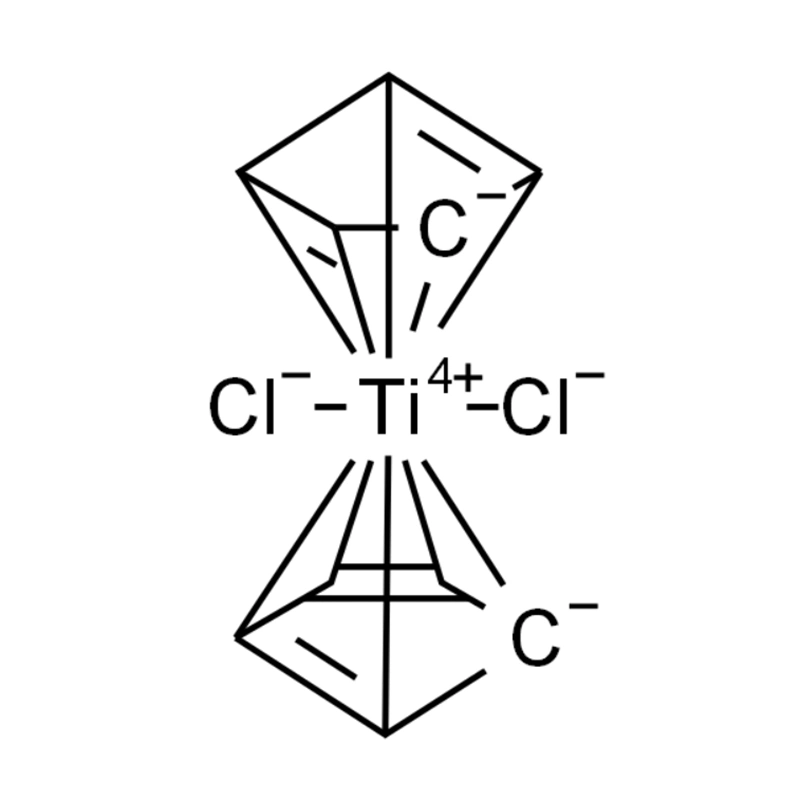
Titanocene Dichloride CAS#1271-19-8 Product Description
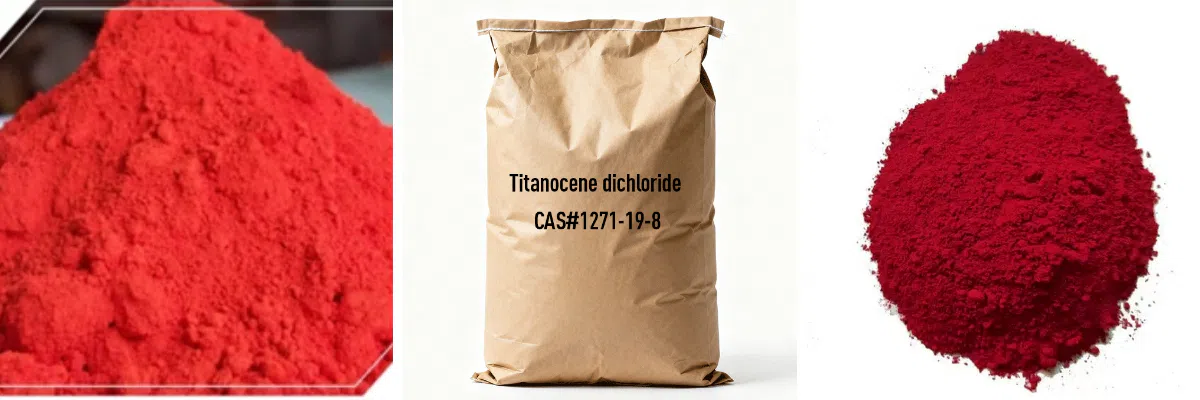
Titanocene dichloride, with the molecular formula (η⁵-C₅H₅)₂TiCl₂ and commonly known as Cp₂TiCl₂, is an organotitanium compound widely utilized in organometallic chemistry and organic synthesis. It typically occurs as a bright red crystalline solid and exhibits relatively slow hydrolysis when exposed to moisture in the air. Owing to its distinctive chemical structure and reactivity, it has attracted considerable interest as a reagent in various chemical transformations and synthetic applications.
Unlike conventional metallocene compounds such as ferrocene, titanocene dichloride does not possess a typical sandwich-like molecular structure. Instead, its coordination environment features two cyclopentadienyl ligands and two chloride ligands arranged around the central titanium atom, resulting in a distorted tetrahedral geometry. This unique coordination structure contributes to its characteristic chemical properties and reactivity.
In addition to its applications in chemical synthesis, titanocene dichloride has also attracted attention in medicinal chemistry due to its reported antitumor activity. It has been investigated as a potential anticancer compound and evaluated in clinical trials for its possible application in cancer chemotherapy, although its clinical development has faced limitations.
Titanocene Dichloride CAS#1271-19-8 Chemical Properties
| Melting point | 260-280 °C (dec.)(lit.) |
| Boiling point | 355.52°C (estimate) |
| density | 1.6 g/mL at 25 °C(lit.) |
| vapor pressure | 0.002Pa at 25℃ |
| storage temp. | Inert atmosphere,Room Temperature |
| solubility | slightly soluble in H2O, benzene; soluble in chloroform,ethanol, toluene |
| form | crystal |
| color | red |
| Specific Gravity | 1.6 |
| Water Solubility | slow decomposition |
| Sensitive | Air & Moisture Sensitive |
| Hydrolytic Sensitivity | 4: no reaction with water under neutral conditions |
| Merck | 149482 |
| Stability: | Stable. Incompatible with strong oxidizing agents. Decomposes in water. Moisture sensitive. |
| LogP | -1.35 at 20℃ |
| CAS DataBase Reference | 1271-19-8(CAS DataBase Reference) |
| NIST Chemistry Reference | Titanocene dichloride(1271-19-8) |
| EPA Substance Registry System | Titanocene dichloride (1271-19-8) |
Titanocene Dichloride CAS#1271-19-8 Safety Information
| Hazard Codes | Xi,T |
| Risk Statements | 37/38-61-40-34-33-36/37/38 |
| Safety Statements | 36-7/8-6A-45-36/37/39-26 |
| RIDADR | UN3261 |
| WGK Germany | 3 |
| RTECS | XR2050000 |
| F | 39742 |
| TSCA | Yes |
| HazardClass | 8 |
| PackingGroup | II |
| HS Code | 29310095 |
| Hazardous Substances Data | 1271-19-8(Hazardous Substances Data) |
| Toxicity | Titanocene dichloride may cause skin and mucous membrane irritation. The LD50 in mice has been reported as 60 mg/kg (i.p.) and 180 mg/kg (i.v.). In the rat, the LD50 is 25 mg/kg (i.p.). |
Titanocene Dichloride CAS#1271-19-8 Product Application
Titanocene dichloride (Cp₂TiCl₂) is widely used as a homogeneous catalyst and organometallic reagent in various chemical transformations, particularly olefin polymerization and hydrogenation reactions. It can facilitate efficient catalytic processes under suitable reaction conditions and is also applicable to one-pot synthesis strategies. For example, it has been employed in the preparation of α-methylene-γ-butyrolactone through reactions involving benzaldehyde and methyl bromoacrylate.
Furthermore, titanocene dichloride exhibits useful catalytic activity in hydrogenation systems, making it a valuable component in polymerization and reduction-related chemical processes. Beyond its applications in industrial and laboratory synthesis, the compound has attracted interest in pharmaceutical and medicinal chemistry because of its reported biological activity, particularly its antitumor properties. It has therefore been investigated as a potential active pharmaceutical compound, although its clinical applications remain limited.