
Products Description
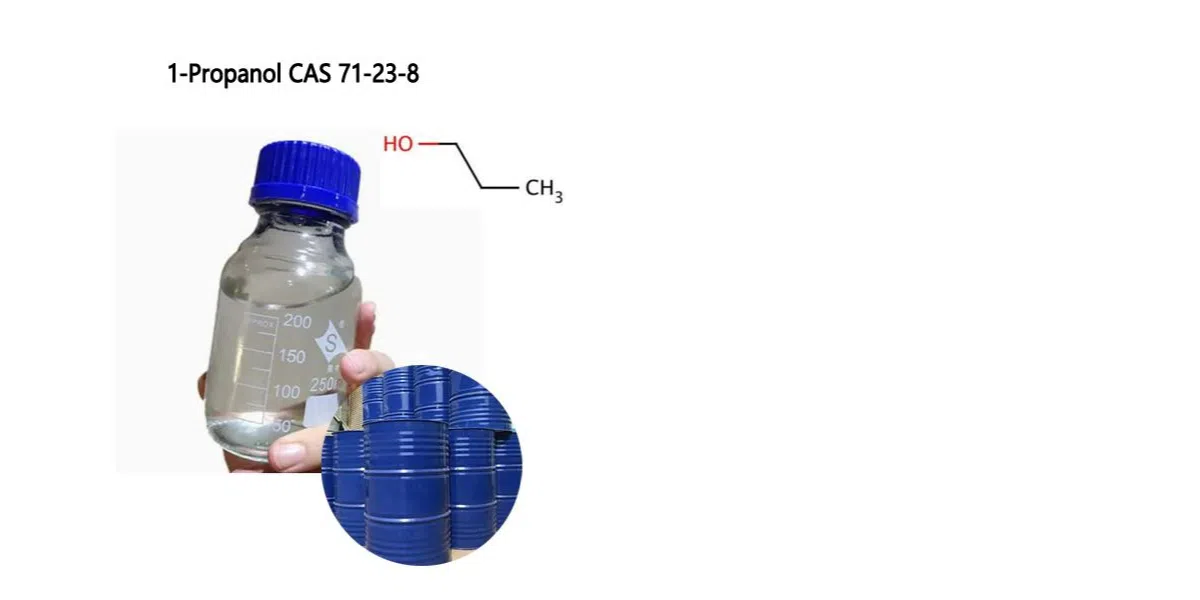
1-Propanolisanorganiccompoundderivedfrompropaneinwhichonehydrogenatomisreplacedbyahydroxylgroup(-OH).Dependingonthepositionofthehydroxylgroupalongthecarbonchain,twostructuralisomerscanbeformed:1-propanol(n-propylalcohol)and2-propanol(isopropylalcohol).
Thechemicalpropertiesof1-propanolaresimilartothoseofethanol.Itcanalsobeproducedasabyproductduringthesynthesisofmethanolfromcarbonmonoxideandhydrogen.Undernormaltemperatureandatmosphericpressure,1-propanolisacolorless,transparentliquidwithacharacteristicalcoholicodor.Industrially,itcanbemanufacturedthroughthereactionofethylene,carbonmonoxide,andhydrogenunderhighpressureinthepresenceofacobaltcatalyst.Otherproductionmethodsincludethehydrationofpropyleneusingsulfuricacidandthecatalytichydrogenationofacetone.
1-Propanoliswidelyusedasanindustrialsolvent.However,exposuretoitmaycauseirritationtotheeyesandmucousmembranes.Inhalationofitsvaporscanalsoresultinadverseeffects,includingdizziness,headaches,nausea,andvomiting.
Chemical Properties
Melting point | -127 °C(lit.) |
Boiling point | 97 °C(lit.) |
density | 0.804 g/mL at 25 °C(lit.) |
vapor density | 2.1 (vs air) |
vapor pressure | 10 mm Hg ( 147 °C) |
FEMA | 2928 | PROPYL ALCOHOL |
refractive index | n20/D |
Fp | 59 °F |
storage temp. | Store at +5°C to +30°C. |
solubility | H2O: passes test |
form | Liquid |
pka | >14 (Schwarzenbach et al., 1993) |
color | <10(APHA) |
Odor | Resembles that of ethyl alcohol. |
Relative polarity | 0.617 |
PH | 7 (200g/l, H2O, 20℃) |
explosive limit | 2.1-19.2%(V) |
Odor Threshold | 0.094ppm |
Odor Type | alcoholic |
Water Solubility | soluble |
λmax | λ: 220 nm Amax: ≤0.40 |
Merck | 14,7842 |
JECFA Number | 82 |
BRN | 1098242 |
Henry's Law Constant | 6.75 (static headspace-GC, Merk and Riederer, 1997) |
Exposure limits | TLV-TWA (200 ppm); (500 mg/m3); STEL 250 ppm (625 mg/m3); IDLH 4000 ppm. |
Dielectric constant | 20.1(25℃) |
Stability: | Stable. May form peroxides in contact with air. Incompatible with alkali metals, alkaline earths, aluminium, oxidizing agents, nitro compounds. Highly flammable. Vapour/air mixtures explosive. |
LogP | 0.33 |
CAS DataBase Reference | 71-23-8(CAS DataBase Reference) |
NIST Chemistry Reference | 1-Propanol(71-23-8) |
EPA Substance Registry System | 1-Propanol (71-23-8) |
Safety Information
Hazard Codes | F,Xi |
Risk Statements | 11-41-67 |
Safety Statements | 7-16-24-26-39 |
RIDADR | UN 1274 3/PG 2 |
OEB | A |
OEL | TWA: 200 ppm (500 mg/m3), STEL: 250 ppm (625 mg/m3) [skin] |
WGK Germany | 1 |
RTECS | UH8225000 |
F | 10-23 |
Autoignition Temperature | 700 °F |
TSCA | Yes |
HazardClass | 3 |
PackingGroup | II |
HS Code | 29051200 |
Hazardous Substances Data | 71-23-8(Hazardous Substances Data) |
Toxicity | LD50 orally in rats: 1.87 g/kg (Smyth) |
IDLA | 800 ppm |
Product Applications
Propanols are widely used as solvents in coatings, antifreeze formulations, household and personal care products. They also serve as important chemical intermediates in the production of esters, amines, and various organic derivatives. In particular, 1-propanol is commonly employed as a solvent in printing inks, paints, cosmetics, pesticides, cellulose esters, and insecticides.
Additionally, 1-propanol is commercially used in the production of glycol ethers. These compounds are characterized by their dual functional properties, which provide excellent solvency, chemical stability, and water compatibility.


