
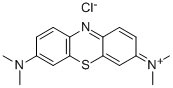
BASIC BLUE 9 Chemical Properties
Melting point | 190 °C (dec.)(lit.) |
density | 1.0 g/mL at 20 °C |
refractive index | n20/D1.347 |
Fp | 45 °C |
storage temp. | room temp |
solubility | Soluble in water, ethanol, ethylene glycol, methyl cellosolve |
form | Liquid |
pka | 2.6, 11.2(at 25℃) |
Colour Index | 52015 |
color | Green |
Specific Gravity | 0.98 |
Odor | Odorless |
Water Solubility | 40 g/L (20 ºC) |
λmax | 661 nm |
Merck | 14,6060 |
BRN | 3641570 |
Biological Applications | Detecting microorganisms; treating diabetic retinopathy,macular degeneration,malignant uveal melanomas,erysipelas,hidradenitis suppurativa,inflammation,skin diseases |
NIST Chemistry Reference | Methylene blue(61-73-4) |
EPA Substance Registry System | Methylene blue (61-73-4) |
Safety Information
Hazard Codes | Xn |
Risk Statements | 10-41-22-20/21/22-36/37/38 |
Safety Statements | 26-39-36 |
RIDADR | UN 1993 3/PG 3 |
WGK Germany | 3 |
RTECS | SP5740000 |
HS Code | 32049010 |
Hazardous Substances Data | 61-73-4(Hazardous Substances Data) |
Toxicity | LD50 oral in rat: 1180mg/kg |
Product Description
Basic Blue 9, commonly known as Methylene Blue or Methylthioninium Chloride, is a synthetic cationic thiazine dye with CAS number 61-73-4. It is characterized by its distinctive deep blue color and is widely used in biological staining, microscopy, laboratory research and dye-related applications.
Main Applications
- Biological Staining: Used for staining selected biological specimens and cellular structures.
- Microscopy: Applied in laboratory microscopy and educational demonstrations.
- Microbiology: Used in selected staining procedures for observing microorganisms.
- Analytical Chemistry: Used as a colorimetric or redox-related reagent in certain analytical methods.
- Industrial Dyeing: Applied as a blue colorant in certain textile, paper and other dye formulations.
- Laboratory Research: Used in scientific research and teaching environments.


